Discover why investor mortgage rates are higher. Learn about the risks that affect loan costs and how to negotiate better terms.
How Mortgage Interest Rates Are Determined: 2026 Guide
Mortgage interest rates are calculated based on a combination of market benchmarks and borrower-specific financial factors. The rate you receive on a home loan is not a single number pulled from a chart. It reflects the 10-year U.S. Treasury yield, investor demand for mortgage-backed securities, your credit score, your loan-to-value ratio, and the loan term you choose. Understanding how mortgage interest rate determination works gives you real leverage when you sit across from a lender. This guide breaks down every layer so you can walk in prepared.
How do financial markets influence mortgage interest rates?
Mortgage rates are anchored to the 10-year U.S. Treasury note yield, not to the Federal Reserve’s short-term rate. As of april 30, 2026, the average 30-year fixed mortgage rate sat at approximately 6.30%, while the 10-year Treasury yield hovered near 4.3%–4.4%. That gap between the two numbers represents the risk premium lenders charge on top of the government benchmark.
Investors who buy mortgage-backed securities (MBS) compare those returns directly to U.S. Treasury bonds. When Treasury yields rise, MBS must offer higher returns to stay competitive, which pushes mortgage rates up. MBS price and demand fluctuate daily, meaning the rate available on a Monday morning can differ from the rate on a Wednesday afternoon.
Several market forces shape where Treasury yields land:
- Inflation expectations: When investors expect prices to rise, they demand higher yields to protect future purchasing power.
- Economic growth forecasts: Strong growth signals higher future rates, pushing yields up.
- Government debt issuance: More Treasury supply in the market tends to push yields higher.
- Global capital flows: Foreign demand for U.S. Treasuries can suppress yields even when domestic conditions suggest otherwise.
“Mortgage rates track more closely with the 10-year Treasury note yield than with the Federal Reserve’s short-term federal funds rate. Inflation expectations and government debt issuance impact Treasury yields and, by extension, mortgage rates.”
This is why you can watch the Fed hold rates steady and still see mortgage rates climb. The two instruments respond to different forces.
What borrower-specific factors affect your mortgage interest rate?
Lenders calculate your rate by starting with a risk-free benchmark like the Treasury yield and then adding a risk premium based on your individual financial profile. The higher your perceived risk, the larger that premium.

Your credit score is the single most visible factor in that calculation. Borrowers with scores of 780 or higher generally qualify for the lowest rates and the widest range of loan products. Borrowers below 640 face the highest rates and the fewest options, often limited to government-insured programs like FHA or VA loans. That spread in rates between a 620 score and a 780 score can represent tens of thousands of dollars over the life of a loan.
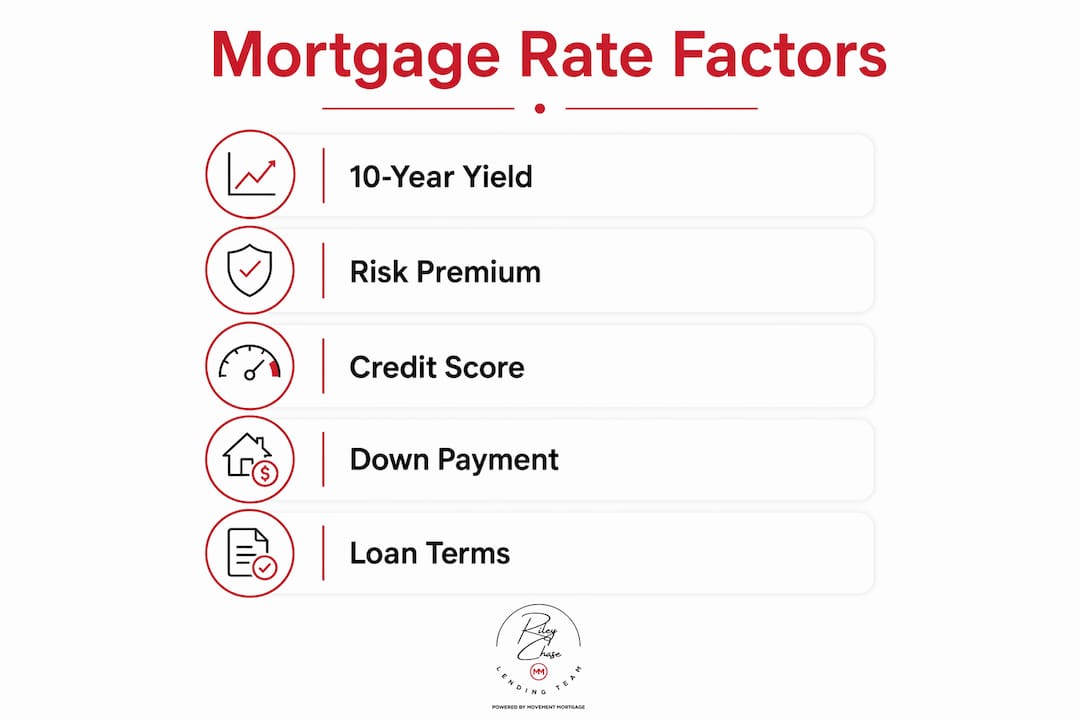
Your loan-to-value ratio (LTV) matters just as much. LTV is the loan amount divided by the home’s appraised value. A buyer putting 20% down carries a lower LTV than one putting 5% down. Borrowers with lower credit scores and higher LTV ratios pay higher rates and often must carry private mortgage insurance, which adds to the total cost of borrowing.
Other factors lenders weigh include:
- Debt-to-income ratio (DTI): A DTI above 43% signals financial strain and raises your rate.
- Loan type: FHA, VA, conventional, and jumbo loans each carry different risk profiles and rate structures.
- Property type: Investment properties and second homes typically carry higher rates than primary residences.
- Loan size: Jumbo loans that exceed conforming limits carry additional risk premiums.
Pro Tip: Check your credit report at least six months before applying for a mortgage. Correcting errors or paying down revolving balances can meaningfully improve your score and lower your rate offer. Rileychase can walk you through what lenders look for in your credit score requirements.
How do rate lock periods and loan terms affect your rate?
A rate lock is a lender’s commitment to hold a specific interest rate for a defined period while your loan processes. Standard lock periods range from 15 to 60 days, aligning with the typical home-buying and underwriting timeline. Longer locks are available but cost more because the lender absorbs more market risk during the extended window.
Locking protects you from rate increases between your offer acceptance and closing day. If rates rise 0.25% during your 45-day lock, you still close at the original rate. The trade-off is that lock fees and timing vary by lender, and a float-down option (which lets you capture a lower rate if the market drops) typically costs extra.
Loan term is the other major lever. Here is how the two most common terms compare:
| Loan Term | Typical Rate | Monthly Payment (on $400,000) | Total Interest Paid |
|---|---|---|---|
| 30-year fixed | Higher | Lower | Significantly more |
| 15-year fixed | Lower | Higher | Significantly less |
Shorter loan terms carry lower rates because the lender recovers its money faster, reducing exposure to long-term inflation and default risk. A 15-year mortgage typically prices 0.5%–0.75% below a comparable 30-year loan. That difference compounds into substantial savings over the life of the loan.
- Confirm your closing timeline before choosing a lock period. A 30-day lock on a complex transaction is a risk.
- Ask about float-down provisions if rates are trending downward during your lock window.
- Compare 15-year and 30-year payments against your monthly budget before committing to a term.
How do broader economic and government policies shape mortgage rates?
The Federal Reserve does not set mortgage rates. This is the most persistent misconception in home financing. The Fed manages the federal funds rate, which is a short-term overnight lending rate between banks. Mortgage rates respond to long-term market expectations, not to Fed announcements directly.
“Mortgage rates are not directly set by the Federal Reserve. They reflect long-term market expectations of inflation, economic growth, and risk premiums demanded by investors in mortgage-backed securities.”
What the Fed does influence is the broader economic environment. When the Fed raises rates to fight inflation, it signals to markets that borrowing costs will stay elevated. That signal raises inflation expectations, which pushes Treasury yields up, which then pulls mortgage rates higher. The mechanism is indirect but real.
Additional systemic forces that shape mortgage rates include:
- Inflation trends: Rising inflation erodes the real return on fixed-income investments, so investors demand higher yields to compensate.
- Government debt supply: When the U.S. Treasury issues large volumes of bonds, yields rise to attract buyers, and mortgage rates follow.
- MBS market liquidity: The risk premium in mortgage rates widens when MBS market liquidity tightens, even if Treasury yields hold steady.
- Global economic uncertainty: Recessions or financial crises abroad can drive capital into U.S. Treasuries, suppressing yields and, in turn, mortgage rates.
Understanding these forces helps you read rate trends rather than react to headlines. Watching the 10-year Treasury yield gives you a reliable leading indicator of where mortgage rates are heading.
What practical steps can you take to get a better mortgage rate?
Your credit profile is the most controllable factor in your rate. Paying down credit card balances below 30% of your credit limit, avoiding new credit inquiries in the months before application, and correcting any errors on your credit report all move your score in the right direction. Even a 20-point improvement can shift you into a better rate tier.
A larger down payment reduces your LTV ratio, which lowers your rate and eliminates the need for private mortgage insurance. Putting 20% down instead of 10% can shave meaningful basis points off your rate and remove a monthly insurance cost that adds nothing to your equity.
Pro Tip: Get rate quotes from at least three lenders on the same day. Rates vary by lender based on their own cost of capital and risk appetite. Comparing quotes within a 24-hour window gives you an apples-to-apples comparison. Rileychase offers transparent rate discussions as part of its mortgage rates overview.
Additional steps that move the needle:
- Choose the right loan type. VA loans offer competitive rates for eligible veterans with no down payment requirement. FHA loans help buyers with lower scores but carry mortgage insurance premiums.
- Time your rate lock carefully. Lock when rates dip, not when they peak. Monitor the 10-year Treasury yield as your signal.
- Reduce your DTI before applying. Paying off a car loan or student loan balance can drop your DTI enough to qualify for a lower rate tier.
- Consider a shorter term if your budget allows. The rate savings on a fixed-rate mortgage with a 15-year term are real and compounding.
Key Takeaways
Your mortgage rate is determined by the 10-year Treasury yield as the baseline, adjusted upward by a risk premium that reflects your credit score, LTV ratio, loan type, and the term you choose.
| Point | Details |
|---|---|
| Treasury yield sets the baseline | The 10-year Treasury note yield is the primary benchmark lenders use before adding risk premiums. |
| Credit score drives your premium | Scores of 780 or higher unlock the lowest rates; scores below 640 limit options and raise costs. |
| LTV ratio affects rate and insurance | A higher down payment lowers your LTV, reduces your rate, and eliminates private mortgage insurance. |
| Loan term changes your rate | A 15-year mortgage typically prices lower than a 30-year loan due to reduced lender risk. |
| Rate locks protect your offer | Standard locks run 15–60 days; longer locks cost more but shield you from market swings. |
What I’ve learned about mortgage rates that most guides skip
Most articles on this topic spend too much time on the Federal Reserve and not enough on the 10-year Treasury yield. After working with borrowers across different rate environments, the single most useful habit I’ve seen is watching the 10-year Treasury daily. When it moves, mortgage rates follow within days. That awareness alone helps buyers time their lock decisions far better than waiting for a Fed announcement.
The second thing I’d push back on is the idea that your rate is mostly out of your hands. Your credit score and LTV ratio are the two biggest levers you actually control. I’ve seen borrowers improve their rate offer by 0.375% simply by paying down one credit card and waiting 60 days before applying. That is not a small number over 30 years.
The third misconception worth addressing: shopping lenders feels uncomfortable for many buyers, as if it signals distrust. It does not. Lenders price loans differently based on their own funding costs and risk models. Getting three quotes is not aggressive. It is standard practice, and it works. Rileychase builds its process around transparency precisely because rate conversations should never feel like a guessing game.
— Riley
Personalized mortgage support from Rileychase
Getting a clear picture of your rate before you make an offer changes everything about the buying process. Rileychase works with first-time buyers and experienced homeowners to explain exactly how their financial profile affects the rate they qualify for, then matches them with the right loan type for their situation.

The pre-approval process at Rileychase gives you a verified rate range based on your actual credit and income, not a generic estimate. From there, you can explore loan options across fixed-rate, adjustable-rate, FHA, and VA programs to find the structure that fits your budget and timeline. Reach out to the Rileychase team at rileychase.com/contact-me to start a conversation with no pressure and no guesswork.
FAQ
What is the primary benchmark for mortgage interest rates?
The 10-year U.S. Treasury note yield is the primary benchmark. Lenders add a risk premium on top of that yield based on borrower credit profiles and loan characteristics.
Does the Federal Reserve directly set mortgage rates?
The Fed does not set mortgage rates. It manages the short-term federal funds rate, while mortgage rates are driven by long-term investor demand for mortgage-backed securities and Treasury yields.
What credit score gets you the best mortgage rate?
Borrowers with FICO scores of 780 or higher generally qualify for the lowest available rates and the broadest range of loan products as of 2026.
How long does a mortgage rate lock last?
Standard rate lock periods run from 15 to 60 days. Longer locks are available but typically cost more because the lender carries additional market risk during the extended period.
How does a larger down payment affect your mortgage rate?
A larger down payment lowers your loan-to-value ratio, which reduces the lender’s risk and typically results in a lower interest rate. It also eliminates the need for private mortgage insurance on conventional loans.
Recommended
- Mortgage Rates and Trends: What You Need to Know to Make Informed Decisions – Movement Mortgage
- Why Mortgage Fees Vary by Lender: 2026 Guide
- Understanding Mortgage Rates: Predictions and Trends for 2024 – Movement Mortgage
- Decoding Current Mortgage Rates: What Homebuyers Need to Know – Movement Mortgage

Related Posts