
Discover why investor mortgage rates are higher. Learn about the risks that affect loan costs and how to negotiate better terms.
Why First-Time Buyer Programs Exist: A 2026 Guide
First-time buyer programs are financial assistance initiatives designed to lower the entry barriers of purchasing a first home, primarily by easing the burden of down payments and closing costs. The industry term for these offerings is “homebuyer assistance programs,” and they operate through federal agencies like HUD, state housing finance agencies, and local governments. Understanding why first-time buyer programs exist starts with one hard fact: home prices have risen faster than incomes for decades, pushing the median age of first-time buyers from 30 to 40 since 1990. These programs exist to close that gap and give you a real path to ownership.
Why first-time buyer programs exist: the economic case
The core problem these programs solve is a widening gap between what homes cost and what most buyers can save. Down payment savings have become the single biggest entry barrier, because monthly payment capacity is rarely the limiting factor for first-time buyers. The challenge is getting to the closing table in the first place.
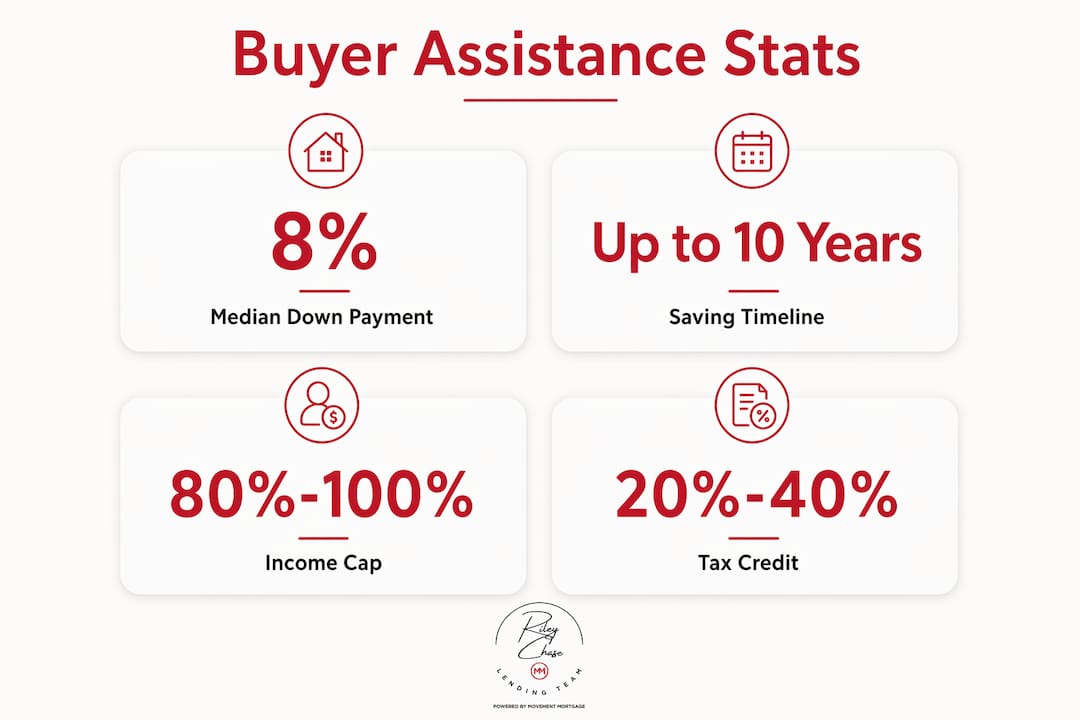
The numbers tell a clear story. The median down payment for first-time buyers was 8% in 2023, compared to 19% for repeat buyers. Repeat buyers use equity from a previous sale. First-time buyers have no such advantage, so they must save from scratch while also paying rent.
The wealth gap compounds over time. Buying a home by age 30 correlates with a 22.5% increase in net worth by age 50. Delay that purchase by a decade, and you lose years of equity growth, tax benefits, and appreciation that repeat buyers have already captured.
The price-to-income ratio shift has stretched saving timelines from roughly 3 years to nearly 10 years in many markets. That delay is not just inconvenient. It directly reduces lifetime wealth accumulation and widens the gap between buyers who inherited equity and those who did not. Homebuyer assistance programs exist specifically to compress that timeline.
| Buyer Type | Median Down Payment | Typical Saving Timeline |
|---|---|---|
| First-time buyer | 8% | Up to 10 years |
| Repeat buyer | 19% | Funded by prior home equity |

What types of assistance do these programs offer?
Most first-time buyer programs in 2026 fall into four main categories. Understanding each one helps you identify which combination fits your situation best.
- Down payment assistance (DPA): Grants or forgivable loans that cover part or all of your down payment. Grants are non-repayable. Forgivable loans are forgiven after you stay in the home for a set number of years, often five to ten.
- Below-market rate mortgages: State housing finance agencies issue Mortgage Revenue Bonds to fund loans at rates below the standard market. These rate reductions can meaningfully lower your monthly payment over a 30-year term.
- Mortgage Credit Certificates (MCCs): MCCs allow eligible buyers to claim 20%–40% of their annual mortgage interest as a direct federal tax credit, not just a deduction. That credit reduces your tax bill dollar for dollar every year you hold the loan.
- Closing cost subsidies: Some programs cover a portion of closing costs, which typically run 2%–5% of the purchase price. Others include incentives for energy-efficient homes, reducing long-term operating costs.
Income eligibility for most programs is capped at 80%–100% of the Area Median Income (AMI) for your county. AMI is the midpoint income for a given area, recalculated annually by HUD. If your household income falls at or below that threshold, you likely qualify for at least one program.
Pro Tip: MCCs are often overlooked because they require a separate application from your mortgage. Ask your lender about MCC availability before you close. You cannot apply retroactively after the loan funds.
Programs also vary by purchase price limits. A home priced above the program cap disqualifies you even if your income qualifies. Check both thresholds before you fall in love with a specific property.
How do eligibility rules work, and what is benefit stacking?
Eligibility for homebuyer assistance programs is more flexible than most buyers expect. The three-year rule is the standard definition: you qualify as a “first-time buyer” if you have not owned a principal residence in the past 36 months. You do not need to be a literal first-time buyer.
Exceptions exist for specific groups. Displaced homemakers, single parents who previously owned only with a former spouse, and buyers who owned a mobile home or non-permanently fixed structure may qualify even with recent ownership history. These exceptions matter because they open access to buyers who might otherwise assume they are ineligible.
Here is how to approach eligibility systematically:
- Confirm your ownership history. Pull your tax records for the past three years. If you claimed no mortgage interest deduction and owned no principal residence, you likely meet the lookback rule.
- Check your income against AMI. HUD publishes AMI tables by county each year. Your lender can pull the current figures for your area.
- Verify the purchase price cap. Each program sets a maximum home price. In high-cost markets, these caps can be a real constraint.
- Apply early. Many programs are supply-limited due to Mortgage Revenue Bond caps. Funds run out, waitlists form, and late applicants miss the window entirely.
- Stack your benefits. Combining a federal FHA or USDA-backed loan with a state down payment grant and a local MCC is the most effective way to reduce upfront costs. Stacking multiple assistance sources from federal, state, and local programs is the best strategy to minimize out-of-pocket expenses.
Pro Tip: Many buyers assume they can only use one program at a time. That is incorrect. Federal loan programs, state grants, and local tax credits are designed to work together. A good mortgage advisor will map out every layer available in your county.
The complexity of stacking is real, but the payoff is significant. A buyer in a well-funded state might combine an FHA loan, a state DPA grant covering 3%–5% of the purchase price, and an MCC reducing annual taxes by hundreds of dollars. That combination can shift homeownership from out-of-reach to achievable within your current budget.
Why do these programs matter beyond the individual buyer?
First-time buyer programs are not just personal finance tools. They function as strategic interventions to level the playing field against generational wealth advantages. Buyers who inherit equity from parents who owned homes have a structural head start. Assistance programs exist to give buyers without that inheritance a comparable starting point.
Homeownership by age 30 yields, on average, $119,000 more in net worth by age 50 compared to buyers who purchase later. Children of homeowners are also statistically more likely to become homeowners themselves, creating an intergenerational cycle that assistance programs help more families enter.
The wealth-building case for early homeownership is strong. Equity grows through appreciation and mortgage paydown simultaneously. Tax benefits like the mortgage interest deduction and capital gains exclusion add further value. Buyers who delay miss years of compounding on all three fronts.
Research from the Incentive Research Foundation confirms that successful buyer incentive programs combine transactional rewards with mandatory education to sustain long-term success. This is why most homebuyer assistance programs require HUD-approved counseling as a condition of participation. The education component is not a bureaucratic hurdle. It directly improves outcomes by preparing buyers for the responsibilities of ownership.
At the market level, these programs reduce imbalances by bringing qualified buyers into the market who would otherwise remain renters. That broader participation supports housing market stability and reduces the concentration of ownership among repeat buyers and investors.
Key Takeaways
First-time buyer programs exist because rising home prices have outpaced income growth for decades, making down payment savings the primary barrier to homeownership for most buyers.
| Point | Details |
|---|---|
| Down payment gap is the core problem | First-time buyers put down 8% vs. 19% for repeat buyers, with no prior equity to draw from. |
| Four main assistance types | Programs offer DPA grants, below-market mortgages, MCCs, and closing cost subsidies. |
| The three-year rule defines eligibility | You qualify if you have not owned a principal residence in the past 36 months. |
| Stacking benefits maximizes savings | Combining federal loans, state grants, and local tax credits cuts upfront costs the most. |
| Early homeownership builds lasting wealth | Buying by age 30 correlates with $119,000 more net worth by age 50 on average. |
What I have learned from watching buyers navigate these programs
Working with first-time buyers, the pattern I see most often is this: buyers wait too long to research programs, then discover the funding ran out. Mortgage Revenue Bond allocations are not unlimited. They reset annually, and popular programs in competitive markets fill up fast. The buyers who benefit most are the ones who start researching six to twelve months before they plan to purchase.
The second mistake I see is assuming ineligibility. Buyers who owned a condo with a former partner, or who lived in a family-owned home without being on the deed, often think they do not qualify. The three-year lookback rule is more forgiving than most people expect. Always verify with a lender before ruling yourself out.
The third thing worth saying plainly: the education requirement most programs attach is genuinely useful. I have seen buyers complete HUD-approved counseling and walk away with a clearer budget, a better credit plan, and a realistic timeline. That preparation makes the difference between a smooth closing and a stressful one. Treat the counseling as an asset, not a checkbox.
The buyers who get the most from these programs combine early preparation, a willingness to stack every available benefit, and a mortgage advisor who knows the local program landscape. That combination is not complicated. It just requires starting earlier than feels necessary.
— Riley
How Rileychase helps first-time buyers find the right path
Rileychase specializes in guiding first-time buyers through the full range of loan options and assistance programs available in their area. From FHA and VA loans to low down payment purchase options, the team works to match your financial situation with the programs that fit it best.

Getting pre-approved for a home loan with Rileychase gives you a clear picture of your budget and strengthens your position when you make an offer. The pre-approval process also surfaces which assistance programs you qualify for, so you can stack benefits before you close. Rileychase combines transparent communication with real expertise in first-time buyer programs, so you move forward with confidence, not guesswork.
FAQ
What is the definition of a first-time homebuyer for program purposes?
Most programs define a first-time homebuyer as someone who has not owned a principal residence in the past 36 months. Exceptions apply for displaced homemakers, single parents, and certain partial-ownership situations.
How much down payment assistance can first-time buyers receive?
Assistance amounts vary by program and location, but grants and forgivable loans commonly cover 3%–5% of the purchase price. Some state and local programs offer more in high-cost markets.
Can you combine multiple first-time buyer programs?
Yes. Stacking federal, state, and local programs is the recommended strategy. An FHA loan, a state DPA grant, and a local Mortgage Credit Certificate can all be used together to reduce upfront and ongoing costs.
What is a Mortgage Credit Certificate and how does it help?
A Mortgage Credit Certificate lets eligible buyers claim 20%–40% of annual mortgage interest as a direct federal tax credit. That credit reduces your tax liability every year for the life of the loan.
Why do first-time buyer programs run out of funding?
Many programs are funded through Mortgage Revenue Bonds, which carry annual volume caps set by federal law. Once those funds are allocated, programs close until the next funding cycle, making early application critical.
Recommended
- First-Time Homebuyer Programs and Incentives: What’s New in 2024? – Movement Mortgage
- How to Navigate the Homebuying Process: A Step-by-Step Guide for First-Time Buyers – Movement Mortgage
- Demystifying the Mortgage Approval Process: A Step-by-Step Guide for First-Time Homebuyers – Movement Mortgage
- First-Time Homebuyer’s Checklist – Movement Mortgage

Related Posts