
Discover why investor mortgage rates are higher. Learn about the risks that affect loan costs and how to negotiate better terms.
How Mortgage Lender Profit Works: A Clear Guide
Mortgage lender profit is defined as the net income a lender earns after covering all costs to originate, fund, and service a home loan. Understanding how mortgage lender profit works matters to you because every fee, rate, and loan term you see is shaped by the lender’s need to cover costs and earn a return. Lenders earn through origination fees, gain on sale, and servicing rights. Yet net profits per loan averaged $443 in 2024 and rose to roughly $950 in mid-2025. Those numbers tell you this is a thin-margin business where volume and efficiency drive everything.
What revenue sources contribute to mortgage lender profits?
Mortgage lenders draw income from four main sources: origination fees, gain on sale, discount points, and servicing rights. Each one affects what you pay and what loan options you can access.
Origination fees are the most visible source of lender revenue. Origination fees typically range from 0.5% to 1% of the loan amount. On a $400,000 loan, that means $2,000 to $4,000 collected at closing to cover administrative and processing costs.

Gain on sale is where most lenders actually make their money. After closing your loan, the lender sells it to investors on the secondary market, usually at a premium above the face value. The spread between what the lender funded the loan for and what an investor pays is the gain on sale. This margin fluctuates with interest rate conditions and investor demand.
Discount points give lenders upfront cash in exchange for lowering your interest rate. Each point costs 1% of the loan amount and typically reduces your rate by about 0.25%. From the lender’s side, points are immediate revenue that offset the lower rate they will earn over time.
Mortgage servicing rights (MSRs) generate ongoing income after the loan is sold. Lenders earn a servicing fee of 0.25% annually on the outstanding loan balance. If a lender sells those rights outright, the sale premium typically runs 1.25% to 1.75% of the unpaid balance. That is a meaningful lump sum on a large loan portfolio.
Pro Tip: Ask your lender to itemize origination fees separately from third-party fees. This makes it easier to compare true lender costs across multiple loan offers.
Understanding why mortgage fees vary across lenders starts with recognizing that each of these revenue streams is priced differently depending on the lender’s business model.
How do lenders manage costs and risks to maintain profitability?
Lender revenue only tells half the story. Production expenses are the other half, and they are substantial. Production expenses rose to $11,898 per loan in Q1 2026. That figure includes underwriting, compliance, technology, and the largest single cost: loan officer compensation.
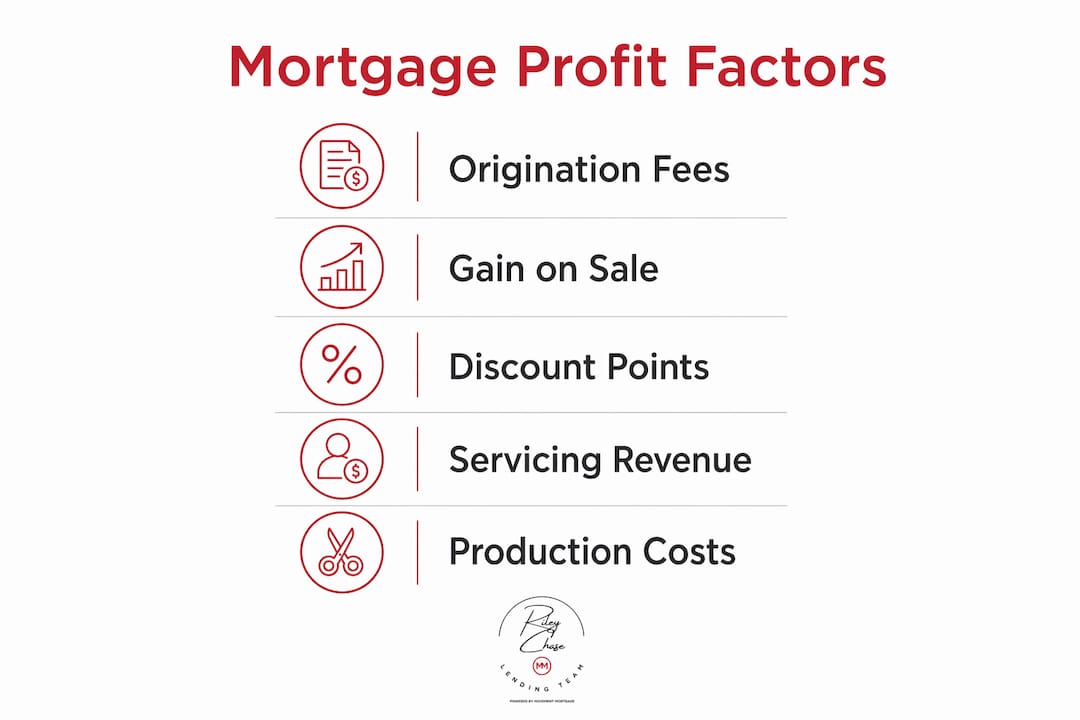
Loan officer compensation represents 65–70% of direct origination costs. That concentration means a lender’s profitability is tightly linked to how productive each loan officer is. Low volume from a highly paid officer can erase the profit from several other loans.
Lenders manage risk and cost through four key practices:
-
Risk-based loan pricing. Lenders price loans on borrower risk and real-time market data, not on the interest rate alone. A borrower with a lower credit score or higher debt-to-income ratio triggers a higher rate to compensate for the increased default risk the lender carries.
-
Hedging before closing. Lenders hedge loans to lock in a sale price on the secondary market before your loan even closes. This protects their gain on sale margin if rates shift between your rate lock date and closing. Hedging adds cost and complexity, but it protects the lender from rate swings that could turn a profitable loan into a loss.
-
Rate lock management. A 60-day rate lock might cost 0.125% of the loan amount, while a 90-day lock can run 0.375% to 0.5%. Lenders embed these costs into your rate or charge them as fees. Delays that push past your lock period often trigger extension fees, which protect the lender’s margin.
-
Volume as the profit engine. Because net profit per loan is so thin, lenders depend on closing a high number of loans each month. Frequent refinancing and loan restructuring reduce lender profits by increasing operational costs without a proportional revenue gain. A borrower who refinances 18 months after closing costs the lender the servicing income they expected to earn for years.
Pro Tip: Closing on time protects you and your lender. Delays that extend rate locks add fees that can show up in your final closing costs.
Why do mortgage lender profits vary so much?
The gap between the most and least profitable lenders is striking. Top-tier lenders achieve 139 basis points of pre-tax production income per loan, while bottom-tier lenders lose 70 basis points. That is a 200-basis-point spread driven by operational discipline, pricing accuracy, and technology.
The industry average pre-tax production profit was 33 basis points in Q3 2025. Most lenders cluster near breakeven, which means small improvements in efficiency or pricing have an outsized impact on profitability.
Three factors explain most of the variation:
| Factor | How it drives profit differences |
|---|---|
| Pricing accuracy | Efficient lenders link pricing to real-time secondary market data; most still use stale models that erode margin |
| Operational discipline | Top lenders manage margin at the loan officer and process level, not just at the portfolio level |
| Compensation structure | Loan officer pay tied to volume and quality reduces waste; flat-fee models can misalign incentives |
The practical implication for you is real. A lender operating at a loss per loan is under pressure to recoup margin somewhere, often through higher fees or less flexible loan terms. A lender running at 139 basis points has room to price competitively and approve a wider range of borrower profiles. Knowing how mortgage interest rates are determined helps you read lender pricing with more confidence.
How does understanding lender profit affect your loan decisions?
Knowing how lenders earn money gives you a real advantage when you shop for a mortgage. You can read a loan estimate more critically, negotiate more effectively, and choose a lender whose business model aligns with your needs.
Here is what to watch for:
- Origination fee line items. A lender charging 1% origination on a $500,000 loan collects $5,000 at closing. Compare this across lenders. Some lenders charge lower origination fees but build margin into a slightly higher rate instead.
- Points and rate tradeoffs. Paying one discount point lowers your rate by roughly 0.25%. Run the break-even math: divide the upfront cost by your monthly savings to find how many months it takes to recoup the cost. If you plan to move or refinance before that point, skip the points.
- Rate lock timing. Locking your rate for exactly as long as you need avoids extension fees. A 30-day lock is cheaper than a 60-day lock. Work with your lender to set a realistic closing timeline before you lock.
- Your risk profile matters to lender pricing. Lenders prioritize predictable loan performance and reward low-friction borrower profiles with better pricing. A strong credit score, stable income, and clean payment history reduce the lender’s risk and can translate directly into a lower rate for you.
- Borrower account conduct shapes approval odds. Borrower loan structuring and account conduct strongly influence lender profitability and approval chances. Lenders look at how you manage existing debt as a signal of how you will manage a mortgage.
Understanding how to improve your mortgage approval chances is partly about understanding what makes you a profitable borrower for the lender. The two goals align more than most homebuyers realize.
Pro Tip: Request a loan estimate from at least three lenders and compare Section A (origination charges) line by line. That section is where lender profit is most directly visible.
Key Takeaways
Mortgage lender profit is a thin-margin, volume-driven business where origination fees, gain on sale, and servicing rights each contribute to earnings that average well under $1,000 per loan.
| Point | Details |
|---|---|
| Profit per loan is slim | Independent mortgage bankers earned $727 per loan in Q1 2026 after nearly $12,000 in production expenses. |
| Four revenue streams drive earnings | Origination fees, gain on sale, discount points, and servicing rights each contribute to total lender income. |
| Top lenders outperform by 200 basis points | The gap between top-tier and bottom-tier lenders reflects pricing accuracy, technology, and operational discipline. |
| Your risk profile affects your rate | Lenders price loans based on borrower risk, so a stronger credit and income profile directly lowers your cost. |
| Rate lock length has a real cost | Longer locks cost more; matching your lock period to your closing timeline avoids unnecessary fees. |
What I’ve learned watching lenders price loans
Most homebuyers assume lenders are making a large profit on their loan. The reality is the opposite. Independent mortgage bankers earned $727 pretax per loan in Q1 2026, against nearly $12,000 in production costs. That is not a business built on fat margins. It is a business built on volume, efficiency, and getting every loan to close cleanly.
What that means for you is actually encouraging. Lenders are not trying to squeeze maximum profit from each individual borrower. They are trying to close loans efficiently and at scale. A borrower who is organized, responsive, and financially clean is genuinely valuable to a lender. You have more negotiating power than you think, especially if you bring a strong file.
The lenders I have seen consistently offer the best terms are the ones running tight operations with real-time pricing tools. They can afford to be competitive because they are not losing margin to inefficiency. When you shop lenders, ask how quickly they can issue a loan estimate and how they handle rate lock extensions. Those two questions reveal a lot about how well-run the operation is.
The borrowers who get the best outcomes are the ones who understand that lender profit and borrower benefit are not opposites. A lender who closes your loan profitably is a lender who will be there for your next purchase too. Align with that incentive and you will get better service, better pricing, and a smoother close.
— Riley
Ready to see what your loan options actually cost?
Rileychase makes the mortgage process clear from the start. When you understand how lender profit works, you can read a loan estimate with confidence and ask the right questions before you sign anything.

Start with a pre-approval for your home loan to see real numbers tied to your specific financial profile. From there, you can compare popular loan options across fixed-rate, FHA, VA, and adjustable-rate products, each with transparent fee structures. Rileychase walks you through every line item so you know exactly what you are paying and why. No surprises at the closing table.
FAQ
What is the average profit a mortgage lender makes per loan?
Independent mortgage bankers earned $727 in pretax net production profit per loan in Q1 2026. Net profit per loan averaged $443 in 2024 and climbed to roughly $950 in mid-2025, reflecting how thin and variable lender margins are.
How do mortgage lenders make money if margins are so low?
Lenders make money through volume, not high per-loan profit. They combine origination fees, gain on sale premiums, and servicing rights income across hundreds or thousands of loans per month to generate meaningful total earnings.
What are mortgage servicing rights and why do they matter?
Mortgage servicing rights give the holder the right to collect monthly payments on a loan in exchange for a fee, typically 0.25% annually of the outstanding balance. Lenders can hold these rights for ongoing income or sell them for an upfront premium of 1.25% to 1.75% of the unpaid balance.
Does a higher origination fee always mean the lender is more profitable?
Not necessarily. A lender charging a higher origination fee may be offsetting a lower interest rate, while another lender builds margin into the rate instead. Compare the total cost of the loan, not just the origination fee line, to get an accurate picture.
How does my credit score affect lender profit and my loan rate?
Lenders price loans based on borrower risk, so a lower credit score signals higher default risk and triggers a higher rate. That higher rate compensates the lender for the added risk, which means improving your credit score before applying can directly reduce what the lender needs to charge you.
Recommended

Related Posts