
Easily understand mortgage loan estimate details with our guide. Compare lenders and make informed decisions as a first-time buyer.
Mortgage Refinancing Explained: A Homeowner’s Guide
Mortgage refinancing is defined as replacing your existing home loan with a new one that offers better terms, a lower interest rate, or access to your home’s equity. The industry term is “mortgage refinance,” and understanding it puts real financial power in your hands. The mortgage refinancing process typically runs 45 to 50 days from application to funding. Closing costs generally fall between 2% and 5% of the loan amount, so knowing what you are getting into before you apply saves you from surprises. This guide walks you through how refinancing works, what it costs, and when it actually makes sense for your situation.
What is mortgage refinancing explained in simple terms?
Mortgage refinancing means you pay off your current home loan by taking out a new one. The new loan can carry a lower interest rate, a different loan term, or both. Homeowners also use refinancing to pull cash from their equity or consolidate debt into one monthly payment.
The core goal is to improve your financial position. You might want to cut your monthly payment, pay off your home faster, or fund a home renovation. Each of those goals points to a different type of refinance, which is why understanding your options matters before you apply.

Lenders treat a refinance application the same way they treat a purchase loan. They re-evaluate your financial profile based on your current credit score, income, and debt load, not the numbers you had when you first bought the home. That means a raise, a new car payment, or a credit score change since your original closing will all affect what you qualify for today.
How does the mortgage refinancing process work?
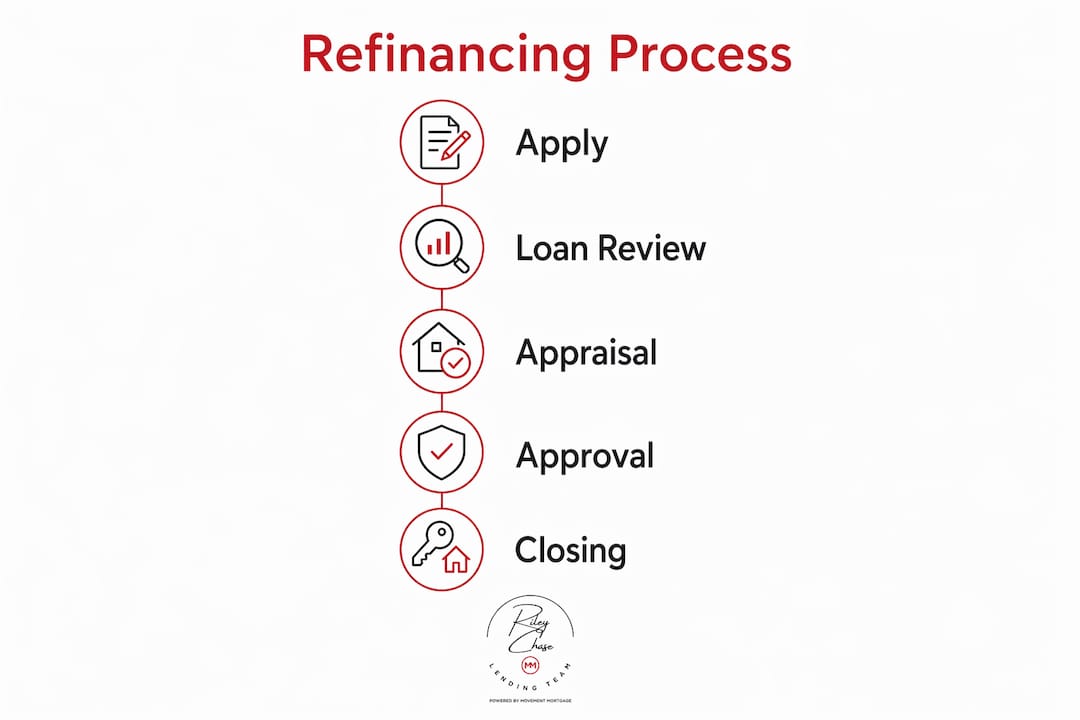
The refinancing process follows a clear sequence. Knowing each step helps you move through it faster and with less stress.
- Submit your application. You provide income documents, tax returns, bank statements, and employment verification. Gathering these before you apply cuts delays significantly.
- Credit check and financial review. Your lender pulls your credit report and reviews your debt-to-income ratio. Most conventional refinances require a minimum credit score of around 620, while FHA refinances may accept scores as low as 580.
- Home appraisal. Most refinances require a property appraisal to confirm current market value. Appraisal fees vary by property size and location but typically run a few hundred dollars. FHA Streamline and VA IRRRL programs can waive the appraisal requirement, which speeds up the process and reduces your upfront costs.
- Underwriting. Automated underwriting software gives a quick risk verdict, but a human underwriter still reviews the full file. New debts or income changes discovered during this stage can delay or alter your approval.
- Closing. You sign the new loan documents, pay closing costs, and the new loan pays off the old one. The whole process from application to funding takes about 45 to 50 days on average.
Pro Tip: Avoid opening new credit accounts or making large purchases between application and closing. Any change to your debt load during underwriting can trigger a re-review and push your closing date back.
What are the common types of mortgage refinancing?
Each refinance type serves a specific financial goal. Choosing the right one depends on what you want to accomplish.
- Rate-and-term refinance. This is the most common type. You replace your current loan with one that has a lower interest rate, a shorter or longer term, or both. The loan balance stays roughly the same.
- Cash-out refinance. You borrow more than your current balance and receive the difference in cash. For example, refinancing a $350,000 balance to a $400,000 loan releases $50,000 in cash for home improvements, education, or other expenses.
- Cash-in refinance. You bring money to closing to pay down your balance. This lowers your loan-to-value ratio, which can help you qualify for a better rate or eliminate private mortgage insurance.
- Debt consolidation refinance. You roll high-interest debts like credit cards or personal loans into your mortgage. The mortgage rate is typically lower, but you are converting unsecured debt into a loan secured by your home.
- Streamline refinance. FHA, VA, and USDA loans each offer simplified refinance programs with reduced paperwork and, in many cases, no appraisal. The VA IRRRL program is one of the most efficient options available for eligible veterans.
Pro Tip: A debt consolidation refinance can lower your monthly payment, but it extends the repayment timeline on what were short-term debts. Run the total interest numbers over the full loan term before committing.
| Refinance type | Best for |
|---|---|
| Rate-and-term | Lowering rate or changing loan length |
| Cash-out | Accessing equity for large expenses |
| Cash-in | Reducing balance and removing PMI |
| Debt consolidation | Combining high-interest debts |
| Streamline (FHA/VA/USDA) | Faster process with less documentation |
What are the costs of refinancing and how do you know if it’s worth it?
Closing costs for a refinance typically run 2% to 5% of the loan amount. On a $300,000 loan, that means paying between $6,000 and $15,000 at closing. These costs include origination fees, appraisal fees, title insurance, and recording charges.
The break-even point is the number that tells you whether refinancing actually saves you money. You calculate it by dividing your total closing costs by your monthly savings. If closing costs are $9,000 and your new payment saves you $300 per month, your break-even point is 30 months. If you plan to sell or move before that point, refinancing is not advantageous.
You can also roll closing costs into the new loan instead of paying them upfront. This avoids an immediate out-of-pocket expense, but you pay interest on those costs for the life of the loan. That adds up over time and pushes your break-even point further out. Use a mortgage calculator to compare both scenarios side by side.
Resetting your loan term is another cost that homeowners often overlook. If you are 10 years into a 30-year mortgage and you refinance into a new 30-year loan, you restart the clock. Your monthly payment may drop, but you will pay interest for 40 years total instead of 30.
Pro Tip: Ask your lender for a Loan Estimate form within three business days of applying. This standardized document breaks down every fee so you can compare offers from multiple lenders on an apples-to-apples basis.
When is the right time to refinance your mortgage?
Timing a refinance well depends on four factors: interest rates, your credit profile, how long you plan to stay in the home, and your loan type’s seasoning requirements.
- Rate drop of roughly 1% or more. A meaningful rate reduction is the clearest signal that refinancing makes financial sense. Smaller drops may not cover closing costs within a reasonable timeframe.
- Strong credit profile. Better credit scores yield better rates and terms. If your score has improved since your original loan, you may qualify for significantly better offers now.
- Long enough stay. You need to remain in the home past your break-even point for the savings to materialize. If you plan to move within two years, the math rarely works in your favor.
- Seasoning requirements. Some loan types require six months to one year of on-time payments before you can refinance. Cash-out refinances generally require longer seasoning periods than rate-and-term refinances.
- Market conditions and personal goals. Falling rate environments favor refinancing, but your personal financial goals matter just as much. Shortening your loan term, eliminating mortgage insurance, or freeing up cash flow are all valid reasons to refinance even when rates have not dropped dramatically.
Pro Tip: Check your credit report at least 60 days before applying. Disputing errors takes time, and a corrected score could move you into a better rate tier before your lender pulls your file.
For a practical look at when to refinance, consider both the current rate environment and your personal financial timeline together, not one without the other.
Key Takeaways
Mortgage refinancing saves money only when your closing costs, loan term, and break-even timeline all align with your financial goals.
| Point | Details |
|---|---|
| Refinancing replaces your loan | A new loan pays off the old one, ideally with better terms or a lower rate. |
| Closing costs are real | Expect 2%–5% of the loan amount; calculate break-even before committing. |
| Credit score matters now | Lenders use your current financial profile, not the one from your original loan. |
| Timing drives the decision | Stay past your break-even point or the savings never materialize. |
| Loan type affects eligibility | FHA, VA, and USDA streamline programs offer faster paths with fewer requirements. |
What I’ve learned from watching homeowners refinance
The biggest mistake I see homeowners make is refinancing for a rate drop that sounds impressive but does not survive a break-even calculation. A 0.5% rate reduction on a $250,000 loan saves roughly $75 per month before taxes. If closing costs run $8,000, you need more than eight years just to break even. That is a long time to commit to staying put.
The second mistake is converting credit card debt into mortgage debt without fully understanding the risk. When you roll unsecured debt into your home loan, your home becomes the collateral for what used to be a credit card balance. If your financial situation worsens, that changes the stakes considerably.
My practical advice: shop at least three lenders before you decide. Rates and fees vary more than most homeowners expect, and a single phone call to a second lender has saved clients thousands of dollars at closing. Prepare your documents early, know your break-even number before you apply, and get a Loan Estimate from every lender you contact. Refinancing done right is one of the most effective financial moves a homeowner can make. Done carelessly, it costs more than it saves.
— Riley
Rileychase is here to help you refinance with confidence
Refinancing is a significant financial decision, and having the right guidance makes the process far less stressful. Rileychase works with homeowners across a wide range of loan types, including fixed-rate, FHA, VA, and adjustable-rate options, to find refinancing solutions that match your actual goals.

Whether you want to lower your rate, shorten your term, or access your equity, the Rileychase team walks you through every step with clear, honest communication. You can review your loan options or connect with a loan officer to get a personalized look at what refinancing could mean for your monthly payment and long-term savings. Getting pre-approved is a fast way to understand exactly where you stand before you commit to anything.
FAQ
What does mortgage refinancing mean?
Mortgage refinancing is the process of replacing your current home loan with a new one, typically to secure a lower interest rate, adjust the loan term, or access home equity.
How long does the mortgage refinancing process take?
The process from application to funding typically takes 45 to 50 days, though complex financial situations or appraisal delays can extend that timeline.
What credit score do you need to refinance a mortgage?
Most conventional refinances require a minimum credit score of around 620. FHA refinances may accept scores as low as 580, and better scores consistently produce better rates and terms.
How do you calculate whether refinancing is worth it?
Divide your total closing costs by your monthly payment savings. The result is your break-even point in months. If you plan to move before reaching that point, refinancing will cost you more than it saves.
Does refinancing hurt your credit score?
Refinancing causes a temporary, minor dip in your credit score due to a hard inquiry and the closing of your existing loan. A single inquiry may reduce your score by up to 5 points, but the effect fades quickly.
Recommended

Related Posts