
Discover why investor mortgage rates are higher. Learn about the risks that affect loan costs and how to negotiate better terms.
First Home Mortgage Application Steps: 2026 Guide
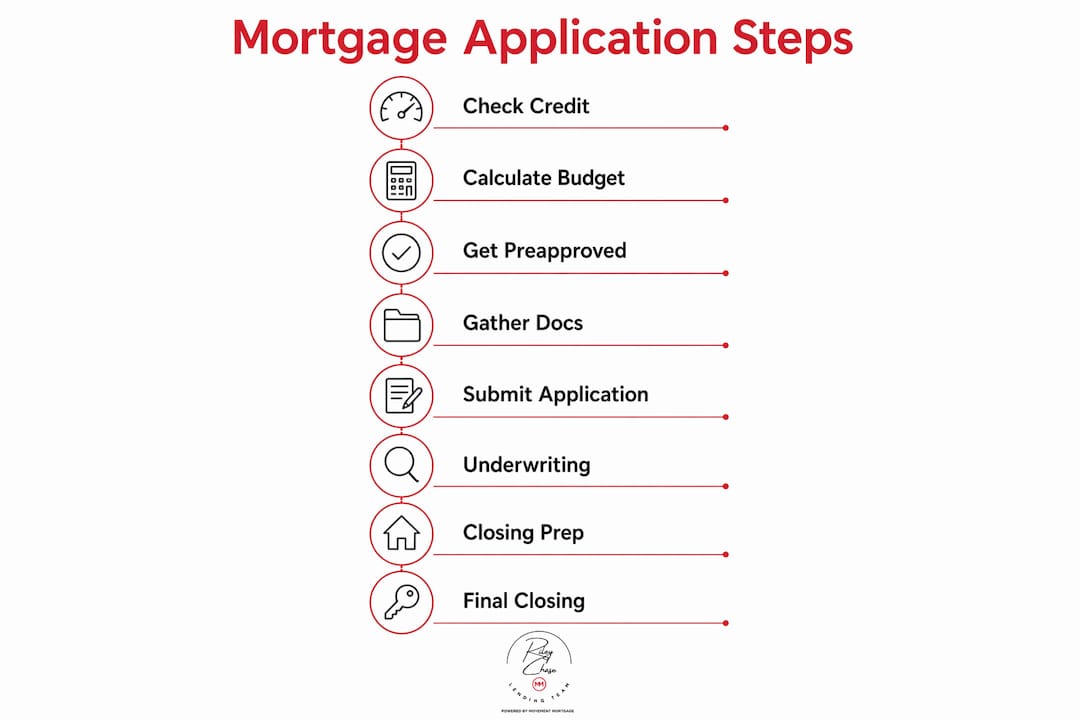
Getting approved for your first home mortgage follows a clear, proven sequence. You start with financial preparation, calculate what you can realistically afford, get preapproved, gather your documents, submit the formal application, move through underwriting, and close on your new home. Each phase builds on the last, and skipping steps is the fastest way to hit delays or denials.
Here is what the process looks like from start to finish:
- Financial preparation: Review your credit, pay down debts, and save for your down payment and closing costs
- Affordability calculation: Determine a realistic home price based on your income, expenses, and debt load
- Preapproval: Submit financial documents to a lender and receive a conditional commitment letter
- Document gathering: Collect pay stubs, W-2s, tax returns, bank statements, retirement account statements, and government-issued ID
- Formal application: Complete the Uniform Residential Loan Application (URLA) accurately with your loan officer
- Underwriting: The lender verifies your finances and orders a property appraisal
- Closing: Sign final documents, pay closing costs and your down payment, and receive your keys
Understanding each of these stages before you begin puts you in a far stronger position than buyers who show up unprepared.
How do you calculate what you can afford before applying?
Your budget is the foundation of the entire mortgage process, and getting it right early saves you from heartbreak later. A general rule of thumb is that your total monthly housing costs, including principal, interest, taxes, and insurance, should stay below a certain percentage of your gross monthly income. Your total debt payments, including the mortgage, should ideally remain at a manageable level.

Your credit score plays a direct role in both your approval odds and the interest rate you receive. Lenders pull your credit report to assess how reliably you have managed debt. There are typical minimum credit score requirements for certain loan types, with FHA loans generally accepting lower scores with specific down payment conditions. Checking your own credit through AnnualCreditReport.com before applying lets you catch errors and dispute them without affecting your score.
Beyond the down payment, budget for closing costs, which can add a notable percentage to your loan amount, plus an emergency fund for repairs and maintenance once you move in. HUD-approved housing counselors offer free guidance on financial readiness and can help you build a realistic savings plan. You can reach them at 800-569-4287.
- Pay down revolving credit card balances to lower your credit utilization ratio
- Avoid opening new credit accounts in the six months before applying
- Keep your employment history stable, since lenders prefer at least two years with the same employer
- Save separately for closing costs so your down payment fund stays intact
Pro Tip: Set up automatic payments on all existing accounts at least six months before you plan to apply. On-time payment history is the single largest factor in your credit score, and a clean six-month run can meaningfully lift your number.
What is preapproval, and which loan type fits your situation?
Preapproval is a lender’s conditional commitment to lend you a specific amount, based on a verified review of your income, assets, and credit. It is more powerful than prequalification, which relies on self-reported numbers. A preapproval letter tells sellers you are a serious buyer with real purchasing power, which can make the difference in a competitive market.

Preapproval letters are legally binding for only 10 days, though most lenders voluntarily honor the terms for 30–90 days. If your home search runs longer, you may need to refresh your preapproval with updated documents. Plan accordingly so you are not scrambling when you find the right property.
Choosing the right loan type is just as important as finding the right lender. The three most common options for first-time buyers are FHA, VA, and conventional loans. Each has distinct eligibility rules, down payment requirements, and credit thresholds.
| Loan Type | Minimum Down Payment | Minimum Credit Score | Key Eligibility |
|---|---|---|---|
| FHA | — | 580 (with — down) | Open to most buyers; requires mortgage insurance |
| VA | — | No official minimum | Active-duty military, veterans, eligible spouses |
| Conventional | a notable percentage | 580–619 | Standard income and credit requirements |
Shopping multiple lenders is smart, and your credit score will not suffer for it. Multiple mortgage inquiries within a 45-day window count as a single hard inquiry, so you can compare rates freely without penalty. For a broader look at loan options available to first-time buyers, the mortgage options overview at Denée Noel’s blog covers several programs worth comparing.
- FHA loans work well for buyers with limited savings or credit scores in the 580–619 range
- VA loans offer the most favorable terms for eligible military borrowers, including no down payment and no private mortgage insurance
- Conventional loans become more attractive once your credit score clears 700 and you can put down 20% to avoid mortgage insurance
What documents do you need for a mortgage application?
The formal mortgage application centers on the Uniform Residential Loan Application, commonly called the URLA or Form 1003. Freddie Mac and Fannie Mae both use this standardized form, and accurate completion is critical. Errors or missing fields are one of the most common reasons applications stall in underwriting.
Your loan officer will complete the lender sections, but you are responsible for the borrower information, financial details, property information, declarations, and acknowledgments. Take your time with every field. A wrong digit on your Social Security number or a missed signature can push your closing date back by weeks.
Gather these documents before you sit down to fill out the application:
- Two years of W-2s or federal tax returns (self-employed buyers need profit and loss statements)
- Recent pay stubs covering the last 30 days
- Bank statements for all checking, savings, and investment accounts, typically the last two to three months
- Retirement and brokerage account statements
- Government-issued photo ID
- Social Security award letters if applicable
- Documentation for any gift funds being used toward the down payment
Pro Tip: Create a dedicated folder, physical or digital, for every mortgage document. Date-stamp everything as you collect it, and double-check that all signature lines are signed before handing anything to your loan officer. A missing signature is the most preventable delay in the process.
Organizing your records well before you apply directly reduces underwriting delays and improves your approval odds. Lenders reward preparedness with faster turnaround times.
What happens during underwriting?
Underwriting is the lender’s deep-dive verification of everything you submitted in your application. An underwriter reviews your credit history, income stability, debt-to-income ratio, employment records, and the property appraisal. Their job is to confirm that the loan is a sound investment for the lender and that you can realistically afford the payments.
Automated underwriting can complete in as few as 15 days, but manual reviews or complex financial situations often take one to two months. The single biggest factor within your control is how quickly you respond to requests for additional documents. Slow responses are the primary cause of bottlenecks. For a deeper look at what underwriters actually examine, Rileychase has a detailed breakdown of what underwriting reviews in a mortgage loan.
Underwriters focus on:
- Credit history: Payment patterns, delinquencies, collections, and recent hard inquiries
- Income stability: Consistent employment, verifiable earnings, and two-year work history
- Debt-to-income ratio: Total monthly debt payments relative to gross monthly income
- Asset verification: Proof that your down payment and reserves are sourced and seasoned
- Property appraisal: Confirmation that the home’s value supports the loan amount
If the underwriter issues a “conditional approval,” they need additional documentation before issuing a final decision. Respond to those requests the same day whenever possible.
What should you expect at closing?
Closing is the final step where ownership officially transfers to you. At least three business days before your closing date, your lender must send you a Closing Disclosure that details your final loan terms, monthly payment, and all closing costs. Read it carefully and compare it line by line against your original Loan Estimate. Discrepancies are rare but worth catching before you sign.
On closing day, you will sign a stack of legal documents, pay your closing costs and down payment, and receive the keys. Bring a government-issued ID and a cashier’s check or wire transfer confirmation for the funds due at closing. Personal checks are typically not accepted.
After closing, your loan may be transferred to a loan servicer, which is the company that collects your monthly payments. Your first payment is usually due 30–60 days after closing, depending on when in the month you close. Set up autopay immediately to protect the credit history you worked hard to build.
- Review the Closing Disclosure for accuracy on interest rate, loan term, and all fees
- Confirm the wire transfer amount with your lender directly to avoid fraud
- Keep copies of every document you sign at closing in a secure location
How do you choose the right lender for your first mortgage?
Not all lenders offer the same rates, fees, or level of support, and the difference can add up to thousands of dollars over the life of your loan. Start by comparing at least three lenders on interest rate, annual percentage rate (APR), origination fees, and customer service reputation. The APR is the more complete cost figure because it includes fees, not just the interest rate.
Ask each lender these questions before committing:
- What loan programs do you offer for first-time buyers?
- What is your average time from application to closing?
- Will I work with one loan officer throughout the process?
- Are there any prepayment penalties on this loan?
- What happens if my rate lock expires before closing?
Your preapproval letter also gives you negotiating leverage. Sellers take offers more seriously when a buyer arrives with a verified preapproval rather than a vague prequalification. For a step-by-step walkthrough of getting preapproved, Rileychase walks you through exactly what to expect. You can also explore the popular home loan types Rileychase offers to find the product that fits your financial profile.
Credit unions, community banks, and mortgage-specific lenders each have strengths. Credit unions often offer lower fees for members. Mortgage-specific lenders tend to have faster processing times and more loan product variety. Online lenders can be competitive on rate but may offer less personalized guidance, which matters most for first-time buyers navigating the process for the first time.
Why do mortgage applications get denied, and how do you avoid it?
Common denial reasons include inaccurate application data, insufficient documentation, poor credit history, a high debt-to-income ratio, and property appraisal shortfalls. Most of these are preventable with preparation.
Inaccurate information is the most avoidable cause. A transposed number or an undisclosed debt can trigger a denial even when your finances are otherwise solid. Double-check every field on the URLA before submitting. If your debt-to-income ratio is too high, paying down a car loan or credit card balance before applying can shift the numbers enough to qualify. A low appraisal is trickier, but you can negotiate the purchase price with the seller or challenge the appraisal with comparable sales data.
Staying responsive throughout the process also matters. Lenders who cannot reach you or who wait weeks for requested documents sometimes withdraw offers. Treat every lender request as urgent.
When does mortgage insurance apply?
Mortgage insurance protects the lender, not you, if you default on the loan. It applies in two main scenarios. On conventional loans, private mortgage insurance (PMI) is required when your down payment is less than 20%. PMI typically cancels automatically once your loan balance drops to 80% of the home’s original value, or you can request cancellation at that threshold.
FHA loans carry a different structure. They require an upfront mortgage insurance premium paid at closing, plus an annual premium divided into monthly installments. Unlike PMI on conventional loans, FHA mortgage insurance often remains for the life of the loan if your down payment was less than 10%. Buyers who put down 10% or more on an FHA loan can have the annual premium removed after 11 years.
VA loans have no mortgage insurance requirement at all, which is one of the most significant financial advantages of that program. Instead, VA loans charge a one-time funding fee, which can be rolled into the loan amount.
Fixed vs. adjustable rates: which one fits your budget?
A fixed-rate mortgage locks your interest rate for the entire loan term, most commonly 15 or 30 years. Your principal and interest payment never changes, which makes budgeting straightforward. If rates rise after you close, you are protected. If rates drop significantly, you would need to refinance to capture the lower rate.
An adjustable-rate mortgage (ARM) starts with a fixed rate for an initial period, typically 5, 7, or 10 years, then adjusts periodically based on a market index. ARMs usually offer a lower starting rate than fixed loans, which can reduce your payment in the early years. The risk is that your rate and payment can increase when the adjustment period begins.
For most first-time buyers planning to stay in their home long term, a fixed-rate loan offers more predictability and peace of mind. An ARM can make sense if you plan to sell or refinance before the initial fixed period ends, or if you expect your income to grow substantially. Talk through both scenarios with your loan officer using actual payment projections before deciding.
Key Takeaways
Completing your first home mortgage application successfully comes down to preparation, accuracy, and staying responsive at every stage of the process.
| Point | Details |
|---|---|
| Start with your credit and budget | Check your credit score and calculate your debt-to-income ratio before contacting any lender. |
| Get preapproved early | A preapproval letter is legally binding for only 10 days, but most lenders voluntarily honor the terms for 30–90 days in practice. This strengthens your offer and clarifies your budget. |
| Rate-shop within 45 days | Multiple mortgage inquiries within a 45-day window count as one hard inquiry, protecting your credit score. |
| Respond fast during underwriting | Automated underwriting can finish in as few as 15 days; slow document responses are the main cause of delays. |
| Review the Closing Disclosure carefully | You must receive this document at least three business days before closing to review final loan terms and costs. |
Ready to take your first step toward homeownership?
Rileychase is here to guide you through every stage of the mortgage process, from calculating your budget to signing at the closing table. Whether you are exploring loan types or ready to move forward, the team at Rileychase brings transparency and personal support to every conversation.
Start your preapproval today and find out exactly how much home you can confidently afford. You can also explore the full mortgage approval process in Rileychase’s step-by-step guide built specifically for first-time buyers.
Recommended
- Demystifying the Mortgage Approval Process: A Step-by-Step Guide for First-Time Homebuyers – Movement Mortgage
- How to Navigate the Homebuying Process: A Step-by-Step Guide for First-Time Buyers – Movement Mortgage
- First Steps to Buy a Home – Movement Mortgage
- Getting Pre-Approved for a Home Loan – Movement Mortgage

Related Posts