
Discover the key mortgage refinance rate factors 2026 affecting homeowners. Learn how current rates can benefit you and save money today!
Why Investor Mortgage Rates Are Higher: What Landlords Need to Know
Yes, mortgage rates for investment properties are consistently higher than for owner-occupied homes. The typical premium runs 0.5%–1.0% above what you’d pay on a primary residence, and that gap exists for two concrete reasons: lenders know from historical data that borrowers protect their primary mortgage first when money gets tight, and most investor loans don’t qualify for the government-backed securitization that keeps owner-occupied rates lower. Understanding both of those forces puts you in a much stronger position to shop, negotiate, and structure your financing.
Table of Contents
- Why do lenders charge more for investment property loans?
- How capital markets push investor rates even higher
- How much higher are investor mortgage rates, exactly?
- How does underwriting differ for investment property loans?
- What loan types are available for investment properties?
- How can you get a lower rate on an investment property loan?
- What extra costs and timing should investors expect?
- Key Takeaways
- What lenders actually see when they quote your investor rate
- Ready to see what your investor rate could look like?
- Useful sources
Why do lenders charge more for investment property loans?
The rate premium isn’t arbitrary. It reflects real, documented risks that lenders price into every investor loan they write.
- Borrower payment priority. Historical data shows that when borrowers face financial stress, they pay their primary mortgage first and let rental loans go delinquent. That behavioral pattern directly raises the expected default rate on investor loans.
- Vacancy and rent volatility. A rental property can sit empty for weeks or months. During that time, you’re still on the hook for the mortgage, taxes, and insurance, but your income stream has stopped. Lenders price that cash-flow uncertainty into the rate.
- Property management and maintenance risk. Tenant turnover, deferred maintenance, and property damage can reduce a property’s recoverable value or extend vacancy periods. These risks don’t exist on a primary residence.
- Occupancy and fraud risk. Non-owner-occupied loans carry a higher incidence of occupancy misrepresentation. Lenders build verification costs and residual risk into pricing.
- Reserve requirements. Lenders typically require six months of PITI reserves on investor loans. The expectation that you’ll hold that liquidity signals the level of risk the lender is managing.
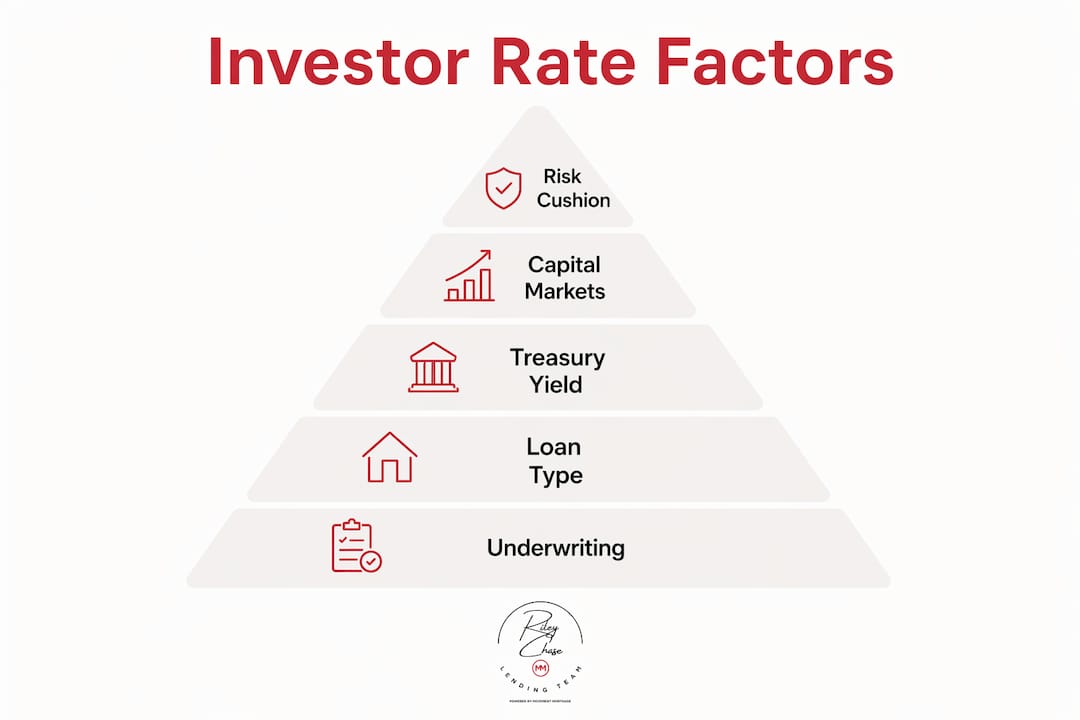
Taken together, these factors function as what Bankrate describes as a “risk cushion” baked into the rate, covering the lender’s exposure to vacancy, rent volatility, and management uncertainty that simply don’t apply to owner-occupied lending.
Pro Tip: Underwriters pay close attention to your documented liquidity. Investors who show strong reserves, a clear rent roll, and a history of on-time payments on existing properties often receive better pricing than those who meet only the minimum thresholds.
How capital markets push investor rates even higher
The rate premium doesn’t come only from borrower behavior. The structure of the mortgage market itself adds another layer of cost for investors.

The Treasury yield connection
Mortgage rates track the 10-year Treasury yield, not the Federal Reserve’s overnight rate. When the Fed raises or cuts its benchmark, mortgage rates don’t move in lockstep. Bond-market dynamics drive long-term mortgage pricing, which is why you can see the Fed hold rates steady while mortgage rates drift higher. Understanding how mortgage interest rates are determined helps you read market signals more accurately.
GSE backing vs. private securitization
Primary-residence loans that meet conforming limits qualify for securitization through Fannie Mae and Freddie Mac. That GSE backing creates deep institutional demand, which compresses the yield investors in those securities will accept, and that compression flows back to you as a lower retail rate. Most investor loans, by contrast, are sold into private or non-QM securitization channels, where buyers demand higher yields to compensate for the absence of government backing. That higher required yield becomes the higher rate you see on your loan estimate.
What’s happening in the market right now
Competition for loanable funds among governments, corporations, and other large borrowers has pushed Treasury yields higher, raising the baseline from which all mortgage rates and trends are set. As market reporting notes, Wall Street is demanding higher returns to deploy capital, and that pressure limits how far mortgage rates can fall even when other conditions improve.
| Rate driver | How it affects investor loans |
|---|---|
| 10-year Treasury yield | Sets the baseline for all long-term mortgage pricing |
| GSE securitization (owner-occupied) | Deep demand compresses yields; lower retail rates |
| Private/non-QM securitization (investor) | Thinner demand requires higher yields; higher retail rates |
| Capital competition (governments, corporations) | Pushes Treasury yields up, raising the baseline for everyone |
How much higher are investor mortgage rates, exactly?
The commonly cited premium is roughly 0.5%–1.0% above a comparable owner-occupied rate, though where you land in that range depends on your credit score, loan-to-value ratio, loan type, and the lender’s own risk appetite.

To make that concrete: On a $350,000 loan at a 30-year fixed rate, paying a higher premium noticeably increases your monthly payment and the total interest paid annually compared to a primary residence loan. Understanding the impact of higher mortgage rates on your cash flow is critical before you commit to a purchase price.
Illustrative only. Actual rates vary by lender, credit profile, and market conditions.
DSCR loans often sit at the higher end of the premium range or beyond it, because they trade in non-QM channels where yields are higher. A strong credit profile and a larger down payment can pull your rate toward the lower end of the spread.
How does underwriting differ for investment property loans?
The rate difference is only part of the story. The qualification requirements are meaningfully stricter, and knowing them in advance helps you prepare a stronger application.
Down payment and LTV
Lenders commonly require a minimum 15% down payment for a single-unit investor purchase, with higher requirements for multi-unit properties. Many conventional investor loans require 20%–25% down to access the best pricing tiers. Lower LTV means less risk for the lender, which translates directly into a lower rate for you.
Credit score expectations
Lenders typically look for scores of 680 or higher for competitive investor-loan pricing. Scores below that threshold usually trigger a higher rate, a larger required down payment, or both. The credit-score effect is more pronounced on investor loans than on primary-residence loans.
Reserve requirements
Six months of PITI reserves is a common benchmark for investor loans. If you own multiple rental properties, some lenders calculate reserves across all of them, which can require substantial liquidity at closing.
Income documentation
Conventional investor loans use your personal income, tax returns, and W-2s. DSCR loans qualify you based on the property’s rental income relative to its debt service, which works well for self-employed investors or those with complex income structures. Portfolio loans may accept alternative documentation at the lender’s discretion.
Occupancy verification
Lenders actively check utility records, tax filings, and sometimes conduct site visits to confirm occupancy status. Misrepresenting an investment property as a primary residence is occupancy fraud, and lenders can call the loan due immediately if it’s discovered. The consequences extend well beyond a rate adjustment.
Application preparation checklist:
- Pull your credit report and resolve any errors at least 90 days before applying.
- Calculate your LTV target and confirm you have the down payment plus reserves in liquid accounts.
- Gather 24 months of tax returns, W-2s or 1099s, and bank statements.
- If using DSCR, prepare a signed lease or market-rent appraisal for the subject property.
- Document all existing rental properties: current leases, rent rolls, and mortgage statements.
- Confirm your reserves cover six months of PITI on the new property, plus any existing investment loans.
Pro Tip: If you own multiple rentals, present your full portfolio performance to the lender upfront. A documented track record of on-time payments and stable occupancy across existing properties can meaningfully improve how underwriters assess your risk.
What loan types are available for investment properties?
Product choice affects both your rate and your qualification path. Here’s how the main options compare.
| Loan type | Who qualifies | Down payment | Rate vs. primary residence | Key trade-off |
|---|---|---|---|---|
| Conventional investor (conforming) | W-2 or self-employed with full docs | 15%–25% | 0.5%–1.0% | Strict income docs; best pricing for strong profiles |
| Conventional investor (non-conforming) | Higher loan amounts; full docs | 20%–30% | +0.5%–1.0% | Above conforming limits; no GSE backing |
| DSCR loan | Investors qualifying on property cash flow | 20%–25% | 0.5%–1.0% | Higher rate; looser personal-income requirements |
| Portfolio loan | Experienced investors; relationship-based | Varies | Varies; sometimes competitive | Lender sets terms; not sold to secondary market |
| FHA / VA | Owner-occupants only | — | N/A for investors | Not available for non-owner-occupied investment properties |
Conventional conforming loans offer the best pricing for investors who can document income and meet the LTV requirements, because Fannie Mae and Freddie Mac do purchase some investor loans within their guidelines. DSCR loans trade convenience for cost: you skip the personal-income documentation, but the non-QM securitization channel means a higher rate. Portfolio loans, held on the lender’s balance sheet, can sometimes be priced competitively for experienced investors or repeat clients, because the lender prices based on the overall relationship rather than secondary-market conventions.
FHA and VA programs are built around owner-occupancy requirements. If you’re wondering whether a VA loan can work for a rental, the short answer is no for a pure investment property, though there are limited exceptions for multi-unit properties where you occupy one unit.
How can you get a lower rate on an investment property loan?
The premium is real, but it’s not fixed. Several levers can move your rate meaningfully.
- Increase your down payment. Moving from 20% to 25% down can drop your rate by 0.25%–0.5% on a conventional investor loan. The LTV improvement reduces the lender’s loss exposure directly.
- Improve your credit score. Crossing from 679 to 680, or from 719 to 720, can unlock a better pricing tier. Even a modest score improvement before you apply is worth the wait.
- Build documented cash reserves. Showing reserves well above the minimum signals financial strength. Lenders have discretion in how they price risk, and strong liquidity is one of the clearest signals you can send.
- Document rental income carefully. If you have existing rentals, a clean rent roll and 12–24 months of deposit history can support a lower risk assessment.
- Consider buying points. On a long-term hold, paying one or two discount points upfront to reduce the rate often makes sense. Run the break-even math: divide the upfront cost by the monthly savings to find your payback period.
- Shop multiple lenders. Rates on investor loans vary more across lenders than on primary-residence loans. A mortgage broker with access to multiple investor-loan programs can surface pricing you won’t find by calling one bank.
- Compare total cost of capital, not just the rate. Origination fees, points, and reserve requirements all affect your true cost. Understanding why mortgage fees vary by lender helps you read loan estimates accurately and compare apples to apples.
Pro Tip: If you own multiple investment properties, ask lenders whether they’ll consider a portfolio or blanket loan structure. Packaging several properties together can sometimes produce better pricing than financing each one individually, because the lender sees a diversified income stream rather than single-property risk.
What extra costs and timing should investors expect?
Beyond the rate itself, investor loans carry additional costs and a longer processing timeline that you should plan for.
- Higher origination fees. Lenders often charge higher origination fees or require more points on investor loans to compensate for the additional underwriting work and risk.
- No mortgage insurance offset. On primary-residence loans with less than 20% down, PMI adds cost but also allows lower down payments. Most investor loan programs require 20%+ down and don’t offer PMI as an alternative, so the full equity requirement hits your cash at closing.
- Reserve liquidity at closing. Six months of PITI reserves must be in your account at closing, in addition to your down payment and closing costs. For a $350,000 loan at 7.5%, that’s roughly $15,000–$18,000 in reserves on top of your other closing funds.
- Longer underwriting timelines. A straightforward conventional investor loan with full documentation typically closes in 30–45 days. A DSCR loan requiring a rental appraisal, lease review, and non-QM underwriting can run 45–60 days or longer.
- Common bottlenecks. Appraisal scheduling, rent-roll verification, and title work on properties with existing tenants are the most frequent sources of delay. Getting your documentation organized before you apply is the single most effective way to keep the timeline on track.
A simple timeline comparison: a well-prepared conventional investor loan closes in roughly 30–35 days. A DSCR loan on a property without an existing lease, requiring a market-rent appraisal and non-QM underwriting, realistically takes 50–60 days. Build that buffer into your purchase contract.
Key Takeaways
Investment-property mortgage rates are higher than primary-residence rates because lenders price in borrower payment-priority risk, income volatility, and the absence of GSE securitization backing, with a typical premium.
| Point | Details |
|---|---|
| Rate premium range | Investor loans typically cost 0.5%–1.0% more than comparable owner-occupied loans. |
| Core risk drivers | Borrower payment priority and non-GSE securitization are the two structural reasons for the premium. |
| Underwriting differences | Expect a substantial down payment, a good credit score, and several months of PITI reserves as baseline requirements. |
| Top tactics to lower your rate | Increase your down payment, improve your credit score, and shop multiple lenders or use a broker. |
| Rileychase | Rileychase offers investor loan options and pre-approval guidance to help you prepare a stronger application. |
What lenders actually see when they quote your investor rate
Most articles on this topic treat the rate premium as a fixed tax on being an investor. From a lender’s perspective, it’s more nuanced than that.
When a loan officer prices an investor loan, they’re working with a risk-adjusted spread above a Treasury benchmark. That spread isn’t a single number pulled from a chart. It reflects your specific credit profile, the property’s income potential, your liquidity, and the product channel the loan will be sold into. Two investors applying for the same loan amount on the same day can receive meaningfully different quotes based on those inputs.
What often gets overlooked is that the premium is most negotiable at the margins. A borrower who comes in with 25% down, a 740 credit score, documented reserves, and a signed lease is presenting a fundamentally different risk profile than someone at the minimum thresholds. Lenders have pricing discretion, and strong documentation is the clearest signal you can send that you’re a lower-risk borrower.
The other thing worth saying plainly: shopping matters more on investor loans than on primary-residence loans. The spread between the best and worst quotes in the market is wider, because fewer lenders compete aggressively for investor business and because product structures vary more. A mortgage broker who works with multiple investor-loan programs regularly will often surface pricing that a single-bank relationship won’t.
At Rileychase, the approach is to work through the numbers with you before you apply, not after you’ve already received a quote you’re not sure how to evaluate. Understanding where you sit on the risk spectrum, and what moves would improve your pricing, is the kind of conversation that’s worth having early.
Ready to see what your investor rate could look like?
Rileychase works with real estate investors at every stage, from first rental purchase to multi-property portfolios. The difference between a good investor loan and a costly one often comes down to preparation: knowing your credit position, having your documentation ready, and understanding which loan product fits your strategy before you apply.

Whether you’re evaluating a DSCR loan, a conventional investor product, or want to understand how your current profile affects your pricing, Rileychase can walk you through your investment loan options and help you build a plan. The next step is straightforward: get pre-approved and find out exactly where you stand before you make an offer.
Useful sources
| Source | What it covers |
|---|---|
| Bankrate: Current Investment Property Rates | Consumer-facing rate guidance; supports the 0.5%–1.0% premium range and the risk-cushion framing |
| Ridge Street Capital: Investment Property Mortgage Rates Today | Market-structure mechanics: Treasury yield benchmarking, GSE vs. private/non-QM securitization, DSCR product pricing |
| JetLending: Investment Property Loan vs. Primary Residence | Underwriting differences: down payment minimums, credit score thresholds, reserve requirements, occupancy fraud controls |
| ENMNEWS: Wall Street Demands Higher Returns to Lend Cash | Current market context: capital competition pushing Treasury yields higher and limiting mortgage-rate relief |
| NMLS Consumer Access | Licensing verification for mortgage lenders and loan officers operating in the United States |
Recommended
- The Impact of Higher Mortgage Rates: What Homebuyers Need to Know – Movement Mortgage
- Mortgage Rates and Trends: What You Need to Know to Make Informed Decisions – Movement Mortgage
- How Rising Interest Rates Impact Your Homebuying Power – Movement Mortgage
- How Mortgage Interest Rates Are Determined: 2026 Guide

Related Posts