
Discover why investor mortgage rates are higher. Learn about the risks that affect loan costs and how to negotiate better terms.
What Is Mortgage Principal? A Clear Guide for Homebuyers
Mortgage principal is the amount you borrowed — or the outstanding balance you still owe — and it’s the number your entire loan is built around. Every interest charge you pay is calculated as a percentage of that balance, and every dollar you pay down builds equity in your home. Understanding it puts you in control of your loan from day one.
Table of Contents
- What is mortgage principal and how does it change over time?
- How does mortgage principal relate to interest?
- What does your monthly mortgage payment actually include?
- How do you calculate the principal and interest split in one payment?
- Why do early mortgage payments mostly go to interest?
- When can your principal or interest change?
- What do extra principal payments actually save you?
- Key Takeaways
- The part most people overlook about principal
- Ready to see your own numbers?
- Useful sources and further reading
What is mortgage principal and how does it change over time?
Your initial principal is straightforward: it’s the purchase price minus your down payment. Buy a home for $300,000, put $30,000 down, and your starting principal is $270,000. That’s the number your lender uses to set your monthly payment and calculate every interest charge going forward.
Outstanding principal is simply what’s left. If you borrowed $250,000 and have repaid $50,000 in principal over the years, your outstanding balance is $200,000. That remaining balance shrinks with each payment you make, and it drops faster when you make extra payments toward the loan.

Two things reduce your outstanding principal: your regular monthly payment (the portion allocated to principal, not interest) and any additional amounts you send in. The lower your balance, the less interest accrues each month, which is why paying down principal early has such a compounding effect on your total loan cost.

How does mortgage principal relate to interest?
Interest is not a fixed fee. It’s a percentage of whatever principal you still owe, recalculated each month. The basic relationship looks like this:
Monthly interest = (annual interest rate ÷ 12) × outstanding principal
On a balance at a 7% annual rate, your first month’s interest charge is roughly the outstanding principal multiplied by the monthly interest rate. The following month, after a portion of your payment has reduced the balance, the interest charge is slightly lower. That pattern repeats for the life of the loan.
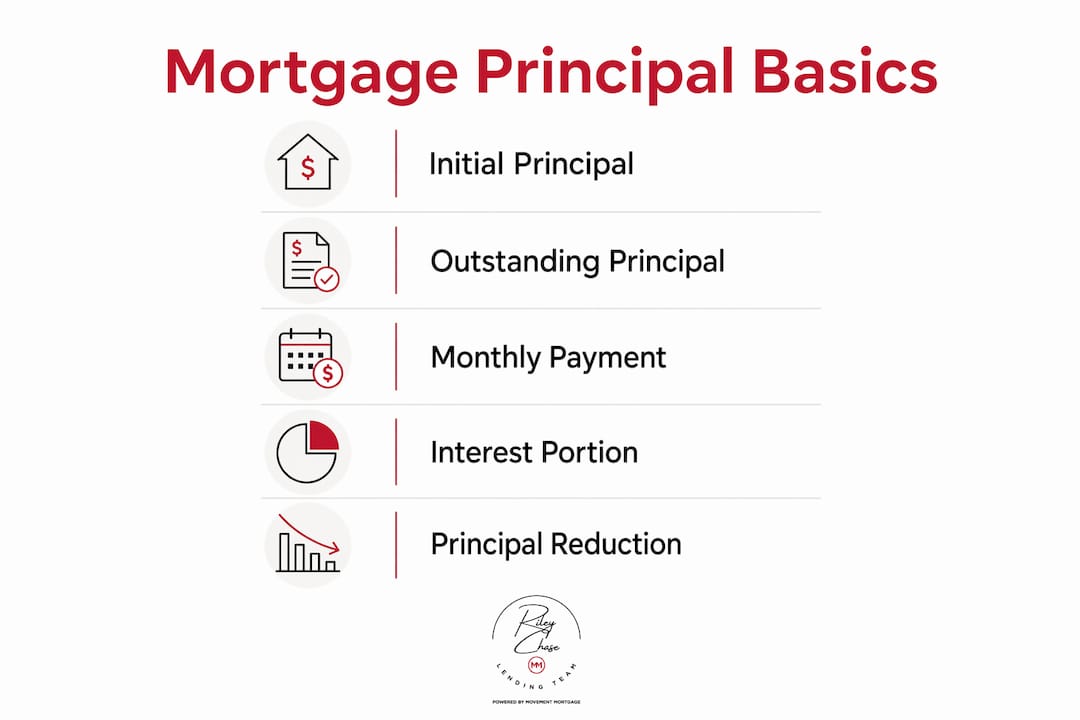
This is why reducing principal early is the most direct way to lower your total interest cost. Every dollar you remove from the balance stops generating future interest charges. The principal and interest portions of your payment are not fixed in dollar terms — they shift every single month as the balance falls.
What does your monthly mortgage payment actually include?
Your monthly payment is usually more than just principal and interest. The Consumer Financial Protection Bureau breaks a standard payment into these components:
- Principal — the portion that reduces your loan balance
- Interest — the lender’s charge for the outstanding balance
- Property taxes — collected monthly and held in escrow
- Homeowners insurance — also escrowed and paid on your behalf
- Mortgage insurance (PMI or MIP) — required if your down payment is below 20% on a conventional loan, or on FHA loans
- HOA dues — if your property is in a homeowners association (paid separately in most cases)
Escrow note: Your lender recalculates escrow annually. If your property taxes or insurance premiums rise, your total monthly payment goes up even though your principal and interest portion stays exactly the same. Many homeowners are surprised by this — it’s not a loan change, just an escrow adjustment.
When you’re comparing loan offers, focus on the principal + interest portion rather than the total monthly payment. Taxes and insurance vary by property and location, so they can distort an apples-to-apples comparison between two loan options.
How do you calculate the principal and interest split in one payment?
You can work out exactly how much of any given payment goes to interest versus principal in three steps.
- Find your monthly interest rate. Divide your annual rate by 12. A 7% loan becomes 0.07 ÷ 12 = 0.005833.
- Calculate the interest portion. Multiply the monthly rate by your current outstanding principal. On a $270,000 balance: 0.005833 × $270,000 = $1,574.91.
- Subtract to find the principal portion. If your fixed monthly payment is $1,797, then $1,797 minus $1,574.91 = $222.09 goes to principal that month.
That $222.09 reduces your balance to $269,777.91. Next month, interest is calculated on that slightly lower number, so a tiny bit more of your payment goes to principal. The shift is small at first, but it accelerates over time.
Pro Tip: Use an amortization calculator to run the full schedule for your loan. Rileychase’s mortgage calculator guide walks you through how to read the results and what the numbers mean for your budget.
Why do early mortgage payments mostly go to interest?
This is amortization at work. With a fixed-rate loan, your monthly payment stays the same from month one to the final payment. What changes is the split between interest and principal. Early in the loan, your outstanding balance is at its highest, so the interest charge consumes most of your payment. Very little is left over to reduce the balance.
As the balance gradually falls, each month’s interest charge shrinks, and the principal portion of your fixed payment grows. By the final years of a 30-year mortgage, the situation has flipped: most of your payment is reducing the balance, and only a small fraction is interest. The CFPB explains that this is by design — the math ensures the loan reaches exactly zero at the end of the agreed term.
A 15-year loan reaches the tipping point much faster. Because the term is half as long, principal pays down more aggressively from the start, and total interest paid over the life of the loan is significantly lower. The tradeoff is a higher monthly payment. Reviewing an amortization snapshot for both options side by side — something Rileychase covers in detail on how a mortgage works — makes that tradeoff concrete and easy to evaluate.
When can your principal or interest change?
Most fixed-rate borrowers see a stable principal-and-interest payment for the life of the loan. But several events can shift the numbers:
- Adjustable-rate mortgages (ARMs): After an initial fixed period, the interest rate adjusts periodically based on a market index. When the rate rises, more of your payment goes to interest; when it falls, more goes to principal. Your total payment amount also changes. Explore how rate buydowns can help manage this risk.
- Refinancing: A refinance replaces your existing loan with a new one, resetting the principal (to your current balance or a new amount if you cash out), the interest rate, and the loan term. The amortization clock restarts, which means early payments on the new loan are again mostly interest.
- Loan recast: Some lenders allow a recast after a large lump-sum payment. The outstanding principal drops, and the lender recalculates your monthly payment based on the new balance and remaining term. Fees apply, and not all loan types qualify.
- Loan modification: In hardship situations, a lender may formally modify the loan terms, sometimes reducing the principal or extending the term to lower payments.
Pro Tip: Before sending a large extra payment, call your servicer and ask how to designate it as “principal only.” Confirm in writing that it will be applied to reduce your balance immediately, not credited as a future installment. The CFPB recommends this step to avoid processing errors that can cost you interest.
What do extra principal payments actually save you?
The math on extra payments is genuinely motivating. Using a loan at 7% over 30 years as a baseline, here’s how the outstanding principal changes over time — and what happens when you add monthly extra principal payments:
Figures are illustrative estimates based on standard amortization math. Use an amortization calculator for your exact numbers.
The difference compounds over time. By year 10, the extra-payment borrower owes roughly $20,000 less. By year 20, the gap has grown to over $40,000 — and the loan is on track to close about five years early. Total interest savings over the life of the loan can be substantial. Investopedia notes that modest recurring extra payments are one of the most effective tools for reducing lifetime interest cost.
The key is making sure those extra dollars are applied correctly. As noted above, confirm with your servicer that the payment is coded as principal-only. You can read more about the mechanics and timing in Rileychase’s guide on extra mortgage payments.
Worth knowing: Extra payments also accelerate home equity — the portion of the home’s value you actually own. Faster equity growth improves your financial position and can open doors to better refinancing terms down the road.
Key Takeaways
Mortgage principal is the foundation of every interest charge and every equity dollar you build — managing it well is the single most impactful thing you can do for your long-term loan cost.
| Point | Details |
|---|---|
| Principal = amount you owe | It starts as purchase price minus down payment; every payment reduces it. |
| Interest is tied to balance | Monthly interest = monthly rate × outstanding principal, so lower balance means lower interest. |
| Compare P+I, not total payment | Escrow items vary by property; the principal + interest portion is the true cost to compare. |
| Extra payments must be labeled | Designate extra funds as “principal only” and confirm with your servicer in writing. |
| Rileychase can run your numbers | Use Rileychase’s resources and loan advisors to model amortization scenarios for your specific loan. |
The part most people overlook about principal
Most homebuyers focus on the interest rate when they’re shopping for a loan. That’s understandable — the rate is the number lenders advertise. But the rate only tells half the story. The other half is how quickly your principal comes down.
A lower rate on a 30-year loan can actually cost more in total interest than a slightly higher rate on a 15-year loan, simply because the balance stays high for so long. Conversely, a borrower on a 30-year loan who makes even modest extra principal payments can outperform a 15-year borrower in terms of flexibility — keeping the lower required payment as a safety net while still paying down the balance aggressively in good months.
The practical takeaway: look at the amortization schedule, not just the rate. Ask your loan advisor to show you the balance at year 5, year 10, and year 15 under different scenarios. That picture tells you far more than a rate comparison alone. And if you’re weighing a 15-year versus 30-year loan, the loan comparison guide at Rileychase is a solid place to start.
Ready to see your own numbers?
Knowing what mortgage principal is gives you a real edge when you’re evaluating loan offers or planning your payoff strategy. Rileychase makes it easy to take that knowledge further. Whether you want help reading an amortization schedule, comparing principal paydown across loan types, or figuring out how much home you can afford, the team is here to walk you through it clearly and without pressure.

The best next step is getting pre-approved for a home loan — it gives you a real principal amount to work with and shows sellers you’re serious. You can also browse loan options to see how different structures affect your principal paydown from day one. Reach out to Rileychase whenever you’re ready.
Useful sources and further reading
These are the authoritative sources behind the facts in this article, plus Rileychase resources for readers who want to go deeper.
U.S. authoritative sources:
- Consumer Financial Protection Bureau — Monthly payment components and escrow: Explains what makes up a total monthly payment and why escrow changes can shift your bill.
- Consumer Financial Protection Bureau — How paying down a mortgage works: Covers amortization, extra payments, and how to confirm principal-only application with your servicer.
- Investopedia — Principal definition: Defines principal across loan and investment contexts; includes guidance on how extra payments reduce lifetime interest.
- Zillow — Mortgage principal explained: Covers initial principal calculation and how the balance decreases over time.
- Business Insider — What is a mortgage principal?: Plain-language definition with numeric examples of outstanding principal.
Rileychase resources:
- How does a mortgage work anyway? — A client-friendly primer on mortgage mechanics, underwriting, and amortization.
- Understanding your mortgage calculator results — Helps you interpret amortization output and apply it to your budget.
- Should you make extra mortgage payments? — A practical guide to the timing, mechanics, and financial impact of extra principal payments.
This article is general educational information, not financial or legal advice. Confirm current rates, loan terms, and program eligibility with a qualified mortgage professional or your lender before making decisions.
Recommended

Related Posts