
Discover why investor mortgage rates are higher. Learn about the risks that affect loan costs and how to negotiate better terms.
How to Negotiate Refinance Closing Costs and Save
You can negotiate most lender-controlled refinance closing costs, and the process is more straightforward than most homeowners expect. CFPB guidance confirms you have the legal right to negotiate mortgage terms and fees right up until you sign the closing documents. The three highest-impact levers are: compare Loan Estimates from at least three lenders on the same day, target Section A origination charges for direct negotiation, and shop title and settlement services from your lender’s shoppable provider list. Refinance closing costs averaged roughly $2,400 nationally in 2025 and often represent about 0.7% of the loan amount, with typical national ranges reported between 1.5% and 3% depending on your state and loan size.
Your three next actions:
- Request Loan Estimates from three or more lenders on the same calendar day so the quotes are directly comparable
- Ask your title company for a reissue rate on lender’s title insurance (you must ask; they rarely apply it automatically)
- Run a break-even calculation: divide total closing costs by your projected monthly savings to see how many months until you come out ahead
Table of Contents
- How to negotiate refinance closing costs step by step
- Which refinance fees are negotiable and which are fixed
- How to use your Loan Estimate and Closing Disclosure as negotiating tools
- What “no-closing-cost refinance” actually means
- How to calculate your break-even and decide if negotiating is worth it
- Your three highest-impact next steps
- What borrowers actually win in negotiations, and what trips them up
- Rileychase can help you negotiate your refinance fees
- Key Takeaways
- The part most guides skip: negotiation is a mindset, not a script
- Useful sources and further reading
How to negotiate refinance closing costs step by step
A strong negotiation starts before you ever speak to a loan officer. Here is the order of operations that gives you the most leverage.
1. Prepare your documents and credit profile
Pull your credit reports from all three bureaus and resolve any errors before applying. Gather your two most recent pay stubs, W-2s, bank statements, and your current mortgage statement. Also locate your existing title insurance policy. That document is your ticket to a reissue discount later. A cleaner credit profile and organized paperwork signal to lenders that you are a low-risk borrower, which gives you more room to push back on fees. For a full prep checklist, the mortgage refinance preparation guide at Rileychase walks through every document you will need.

2. Request Loan Estimates from three or more lenders on the same day
Timing matters here. Comparing multiple lenders is the single most effective tactic in refinance closing costs negotiation, and getting all quotes on the same day means the rate environment is identical for each. Ask each lender for a formal Loan Estimate, not just a verbal quote or a rate sheet. The LE is a standardized three-page form that lets you compare fees line by line.
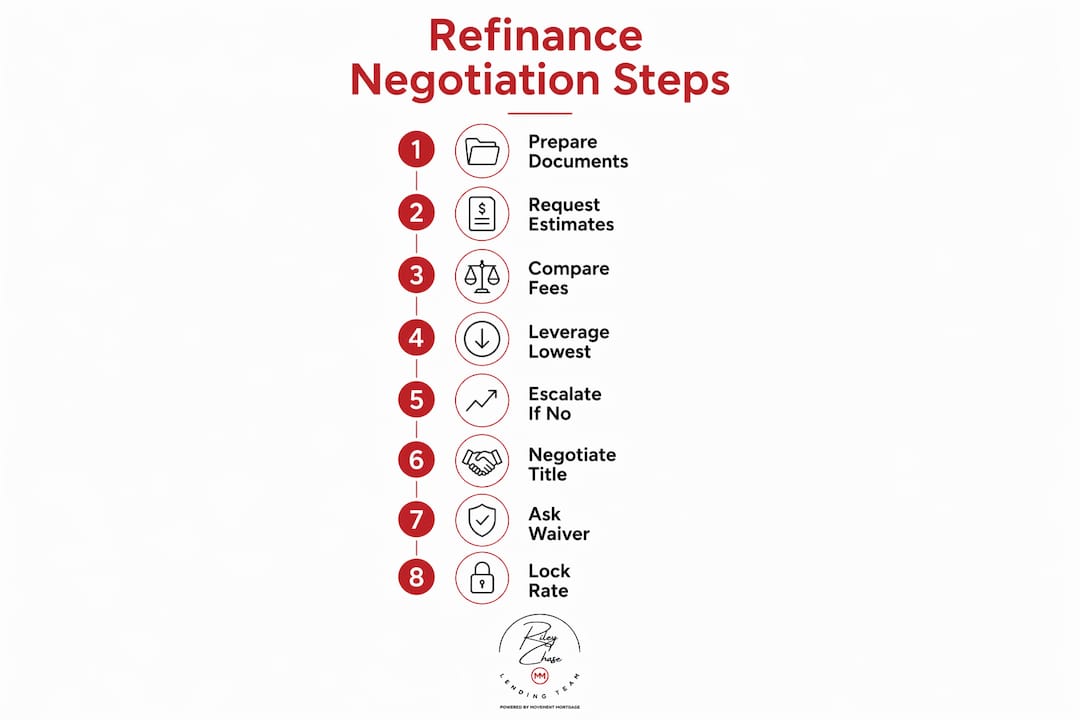
3. Compare Section A across all Loan Estimates
Section A of the LE lists origination charges: the origination fee, application fee, underwriting fee, and processing fee. This is where lender margin sits and where you have the most negotiating room. Origination charges typically run 0.5%–1% of the loan amount. On a $350,000 refinance, that is $1,750–$3,500 in fees that are directly negotiable.
4. Use the lowest LE as written leverage
Print or screenshot the competing Loan Estimate with the lowest Section A total. Send it to your preferred lender in writing, either by email or through their secure portal. Ask specifically: “Can you match or beat the origination charges on this competing estimate?” Written requests work better than phone calls because they create a paper trail and signal that you are serious. Many loan officers have discretion to issue credits or waive internal fees when presented with a competing offer in writing, but they rarely do it proactively.
5. Escalate if the loan officer says no
If your loan officer cannot move on fees, ask to speak with a branch manager or a senior loan officer. Frame it as wanting to keep your business with their institution. A manager often has more authority to approve a lender credit or waive an application fee.
6. Negotiate with your title company separately
Contact the title company on your lender’s shoppable provider list and ask two things: whether they offer a reissue rate on the lender’s title insurance policy, and whether their settlement fee is negotiable. Title insurance reissue rates can produce meaningful savings on refinances, but you must present your prior title policy to qualify. Title companies do not apply reissue discounts automatically.
7. Ask about appraisal waiver eligibility
Many conventional refinances qualify for an appraisal waiver through Fannie Mae’s Desktop Underwriter or Freddie Mac’s Loan Product Advisor. Ask your lender upfront whether your loan-to-value ratio and loan history make you eligible. Skipping the appraisal saves $400–$700 in most markets.
8. Lock your rate for 45–60 days and get the extension policy in writing
Pro Tip: Ask your lender to confirm in writing that if a delay on their end forces a rate-lock extension, they will waive the extension fee. A 45–60 day initial lock gives you a buffer; the written waiver policy protects you if the lender’s processing runs long.
Which refinance fees are negotiable and which are fixed
Not every line on your Loan Estimate has the same flexibility. Knowing where your leverage is saves you time and keeps negotiations focused.
Negotiable fees (Section A and shoppable services)
Understanding closing costs starts with recognizing that lender-controlled fees are where you have real power:
- Origination fee: Typically 0.5%–1% of the loan amount; directly negotiable with the lender
- Application fee: Often $0–$500; frequently waived when you present a competing LE
- Underwriting fee: $400–$900 range; negotiable, especially when you have a strong credit profile
- Processing fee: $300–$700; sometimes bundled into origination, sometimes listed separately
- Title search and settlement fees (Section C): Shoppable; you can use any provider on the lender’s approved list
- Lender’s title insurance: Ask for a reissue rate if you refinanced or purchased within the last 10 years
Fixed or pass-through fees (not negotiable)
| Fee Type | Why It’s Fixed |
|---|---|
| Recording fees | Set by county government |
| Transfer taxes | State/local statute; not all states charge on refis |
| Prepaid interest | Determined by your closing date |
| Homeowners insurance escrow | Based on your actual policy premium |
| Property tax escrow | Based on your actual tax bill |
| Government mortgage insurance (FHA/VA) | Set by program rules |
Government and statutory fees are pass-throughs. The lender collects them and forwards them to the appropriate agency or municipality. No amount of negotiation changes those numbers.
How to use your Loan Estimate and Closing Disclosure as negotiating tools
The Loan Estimate and Closing Disclosure are not just paperwork. They are your primary tools for catching overcharges and holding lenders accountable.
Reading the Loan Estimate
The LE arrives within three business days of your application. Page 2 breaks fees into labeled sections. Section A is lender charges (negotiable). Section B is services you cannot shop for (appraisal, credit report). Section C is services you can shop for (title, settlement). Section E is taxes and government fees (fixed). When you compare Loan Estimates across lenders, focus your comparison on Sections A and C, since those are the only lines where shopping or negotiating actually moves the number.
The tolerance rules that protect you
CFPB tolerance rules govern how much fees can increase between your LE and your final Closing Disclosure:
| Tolerance Category | What It Covers | Maximum Allowed Increase |
|---|---|---|
| Zero tolerance | Section A lender charges, transfer taxes | $0 (any increase is a violation) |
| 10% tolerance | Section C shoppable services (if you used lender’s list) | 10% aggregate |
| No tolerance limit | Prepaids, escrow deposits, homeowners insurance | Can change without limit |
What to do when a fee increases beyond tolerance
You receive the Closing Disclosure at least three business days before closing. Compare it line by line against your original LE. If a zero-tolerance fee increased at all, or if the 10% bucket grew by more than 10% in aggregate, the lender is required to cure the difference.
Pro Tip: Send this email if you spot a tolerance violation: “I am reviewing my Closing Disclosure against my Loan Estimate dated July 30, 2026. I notice [fee name] increased from $[LE amount] to $[CD amount]. Per CFPB tolerance rules, this fee falls in the zero-tolerance category. Please confirm in writing how this will be cured before closing.”
What “no-closing-cost refinance” actually means
A no-closing-cost refinance is not free. The costs are simply paid differently. There are three structures, and each has a different long-term price tag.
The three models
- Higher rate for lender credit: The lender raises your interest rate slightly and applies the resulting credit to offset your closing costs. You pay nothing upfront but carry a higher rate for the life of the loan.
- Roll costs into the loan balance: Your closing costs are added to the principal. You pay interest on those costs for as long as you hold the loan.
- Lender credits for specific fees: The lender credits specific line items (origination, underwriting) in exchange for a rate premium. Similar to model one but sometimes applied selectively.
No-closing-cost refinances trade upfront fees for a higher rate or a larger balance, and rolling costs into the loan increases total interest paid over time.
Pros and cons at a glance
- Higher rate / lender credit: Good if you plan to sell or refinance again within 3–4 years; costly if you stay long-term
- Roll into balance: Preserves cash now but compounds the cost over the loan term
- Pay upfront: Best long-term value if your break-even period is under 36 months and you plan to stay
Simple cost comparison example
Assume a $300,000 refinance with $6,000 in closing costs and a monthly savings of $150 versus your current payment.
| Scenario | Upfront Cost | Monthly Payment Increase vs. Paying Upfront | 5-Year Total Cost |
|---|---|---|---|
| Pay closing costs upfront | $6,000 | $0 | $6,000 |
| Roll into loan (30-yr at 7%) | $0 | ~$40/month | ~$8,400 |
| Higher rate (adds $50/mo) | $0 | $50/month | ~$9,000 |
The upfront option wins at the 5-year mark. At 3 years, the no-cost options look more competitive because you have not yet recouped the $6,000. That is exactly why the break-even calculation matters.
How to calculate your break-even and decide if negotiating is worth it
The break-even period is the single most important metric when deciding whether to negotiate fees aggressively or accept a no-cost option.
The formula
Break-even (months) = Total closing costs ÷ Monthly payment savings
Worked example
- Current mortgage payment: $2,100/month
- New payment after refinance: $1,920/month
- Monthly savings: $180
- Total closing costs: $5,400
Break-even = $5,400 ÷ $180 = 30 months (2.5 years)
If you plan to stay in the home for at least 30 months, paying the closing costs upfront makes financial sense. If you expect to move or refinance again within 18 months, a no-cost option is likely the smarter call.
Sensitivity factors
| Factor | Impact on Decision |
|---|---|
| Short time horizon (under 24 months) | Favor no-cost option or lender credits |
| Long time horizon (5+ years) | Push hard for lowest fees upfront |
| Low cash reserves | Consider rolling costs in, but calculate total interest added |
| Rate expected to drop further | Shorter break-even preferred; keep options open |
For help interpreting your monthly savings estimate, the mortgage calculator guide at Rileychase walks through how to read the numbers accurately.
Decision rule: When your break-even is under 24 months, negotiate aggressively for the lowest fees. When it stretches past 36 months, a no-cost structure often costs you less in practice, especially if rates are still moving.
Your three highest-impact next steps
Refinancing cost savings come down to preparation, comparison, and asking directly. Here is what to do this week:
- Get three Loan Estimates on the same day. Multiple lender comparisons are the most reliable way to reduce what you pay; many borrowers overpay simply by not comparing offers.
- Ask for the reissue title rate. Call the title company, mention you have a prior policy, and request the reissue discount. This one question can save you hundreds of dollars.
- Run your break-even number. Use the formula above before you decide between paying upfront or accepting a higher rate. The math takes five minutes and changes the entire decision.
Origination charges are your biggest leverage point. A written competing Loan Estimate is your most powerful tool. Most lenders will negotiate when they see a real competing offer in writing.
Pro Tip: If you want a second set of eyes on your Loan Estimates before you respond to any lender, a mortgage advisor can spot padding, flag tolerance issues, and help you draft a fee-match request. That conversation costs you nothing upfront.
What borrowers actually win in negotiations, and what trips them up
The most consistent wins happen when a borrower shows up with a written competing Loan Estimate. Loan officers frequently have discretion to issue credits or waive internal fees in that situation, but they almost never do it without being asked. A written request, not a phone call, is what tends to move things. Common concessions include origination fee reductions, application fee waivers, and rate-lock extension fee waivers when the lender caused the delay.
The most common mistake is accepting the first verbal quote. A loan officer quoting you a rate and fees over the phone is not a Loan Estimate. It is not binding, it is not standardized, and you cannot use it as leverage. Get the formal LE in writing before you compare anything.
The second mistake is comparing monthly payments instead of total cash-to-close. A lender can show you a lower payment while burying higher fees in the loan. Always compare the total cash-to-close figure on Page 1 of each LE alongside the interest rate.
The third mistake is skipping the reissue title rate conversation. Most homeowners who refinanced or purchased within the last decade qualify for a discounted lender’s title premium. The title company will not bring it up. You have to ask, and you need to present your prior policy to get it.
Documentation that tends to persuade loan officers: a printed or PDF copy of the competing LE, your current title insurance policy, and a recent credit score snapshot showing your profile. Those three items, presented together in writing, give you a credible, organized negotiating position.
Rileychase can help you negotiate your refinance fees
Refinance closing costs negotiation works best when you have someone in your corner who knows which fees move and which ones don’t. Rileychase, part of the Movement Mortgage family, helps homeowners get competitive Loan Estimates, identify origination charges worth pushing back on, and run the break-even math before you commit to any structure.

When you work with Rileychase, you get a transparent breakdown of every fee on your Loan Estimate, guidance on whether a no-cost option or upfront payment fits your timeline, and direct help drafting fee-match requests when a competing offer is on the table. The process starts with a straightforward consultation, and you come in with your documents ready: two recent pay stubs, your last two bank statements, and your current mortgage statement.
Ready to see what your refinance could actually cost? Explore your loan options with Rileychase and get a clear picture of your fees before you commit to anything.
Key Takeaways
Negotiating refinance closing costs is a legal right, and the single most effective tactic is presenting a written competing Loan Estimate to your preferred lender.
| Point | Details |
|---|---|
| You can negotiate until signing | CFPB confirms borrowers have the right to negotiate lender-controlled fees up to closing. |
| Section A is your leverage | Origination, underwriting, and processing fees (0.5%–1% of loan) are the primary negotiable bucket. |
| Break-even drives the decision | Divide total closing costs by monthly savings; under 24 months favors upfront fees, over 36 months favors no-cost options. |
| Reissue title rates require asking | Title companies don’t apply reissue discounts automatically; present your prior policy and request it directly. |
| Rileychase helps you compare and negotiate | Rileychase provides transparent Loan Estimate comparisons and fee-negotiation guidance through Movement Mortgage. |
The part most guides skip: negotiation is a mindset, not a script
Most refinance articles hand you a checklist and call it a day. What they underestimate is that refinance closing costs negotiation is less about the exact words you use and more about the posture you bring to the conversation. Lenders are not adversaries. They want your business. When you show up with a competing Loan Estimate in hand, you are not being aggressive. You are being an informed consumer, and that is exactly what the process is designed for.
The conventional wisdom says to “shop around.” That is true but incomplete. Shopping around only works if you actually use what you find. Too many homeowners collect three quotes, feel good about having done their research, and then go back to the first lender without ever mentioning the competing offers. The leverage disappears the moment you stop using it.
There is also a tendency to focus entirely on the interest rate and ignore the fee side of the equation. A rate that is 0.125% lower can look attractive until you realize the origination charges are $2,000 higher. The total cost of the loan, fees included, is the number that matters. The Loan Estimate exists precisely to make that comparison possible. Use it.
One more thing worth saying directly: the borrowers who get the best outcomes are not the ones who negotiate the hardest. They are the ones who prepare the most. A clean credit profile, organized documents, a competing LE, and a clear sense of their break-even number put you in a position where the lender has every reason to work with you. That preparation is worth more than any script.
Useful sources and further reading
- CFPB: Am I allowed to negotiate mortgage terms and costs at closing? — Primary authority on borrower negotiation rights and which fees are within lender control
- CFPB: What is owner’s title insurance? — Explains reissue rates and how title insurance works on refinances
- CFPB: How to compare mortgage offers — Guidance on using the break-even calculation and comparing Loan Estimates
- Rileychase: Mortgage Loan Estimate explained — Detailed walkthrough of the LE form and how to read each section
- Rileychase: How to prepare for a mortgage refinance — Document checklist and preparation steps before applying
- Rileychase: Why mortgage fees vary by lender — Explains the drivers behind origination charge differences across lenders
This article is general educational information, not legal or financial advice. Confirm current rates, fees, and program rules with a licensed mortgage professional or the relevant regulatory authority for your specific situation.
Recommended

Related Posts