
Discover why investor mortgage rates are higher. Learn about the risks that affect loan costs and how to negotiate better terms.
The Role of the Secondary Mortgage Market Explained
The secondary mortgage market is the system that lets lenders sell the home loans they originate, bundle them into securities, and use the proceeds to fund new mortgages. Without it, most lenders would run out of capital after a handful of loans. Trillions of dollars move through this market annually, connecting your local lender to pension funds, insurance companies, and investors worldwide. The three names you’ll hear most often are Fannie Mae, Freddie Mac, and Ginnie Mae, and the primary instrument they use is the mortgage-backed security (MBS).
Here’s what that means for you as a homebuyer:
- Mortgage rates stay lower because global investor demand for MBS creates a steady, competitive source of capital.
- Long-term fixed-rate loans exist because lenders can sell 30-year mortgages rather than hold them for decades.
- More loan options are available because standardized underwriting lets lenders originate at scale.
- Your servicer may change after closing, even though your loan terms stay exactly the same.
FHFA data shows that three-quarters of the dollar volume of single-family loans are now funded through MBS sales, up from three-fifths in 2001. That number tells you how central this market is to everyday homebuying.
Table of Contents
- How a mortgage moves from your closing table to global investors
- Who the main participants are and what each one does
- Why the secondary market matters to you — benefits and real trade-offs
- Agency MBS, Ginnie Mae securities, and private-label MBS: what’s the difference?
- How investor demand and GSE actions shape the rates you’re quoted
- A brief history: how the secondary market got here and what 2008 changed
- Practical steps to take when talking to your lender
- Key Takeaways
- What I’ve seen working with borrowers on this
- Ready to put this knowledge to work?
- Authoritative sources and further reading
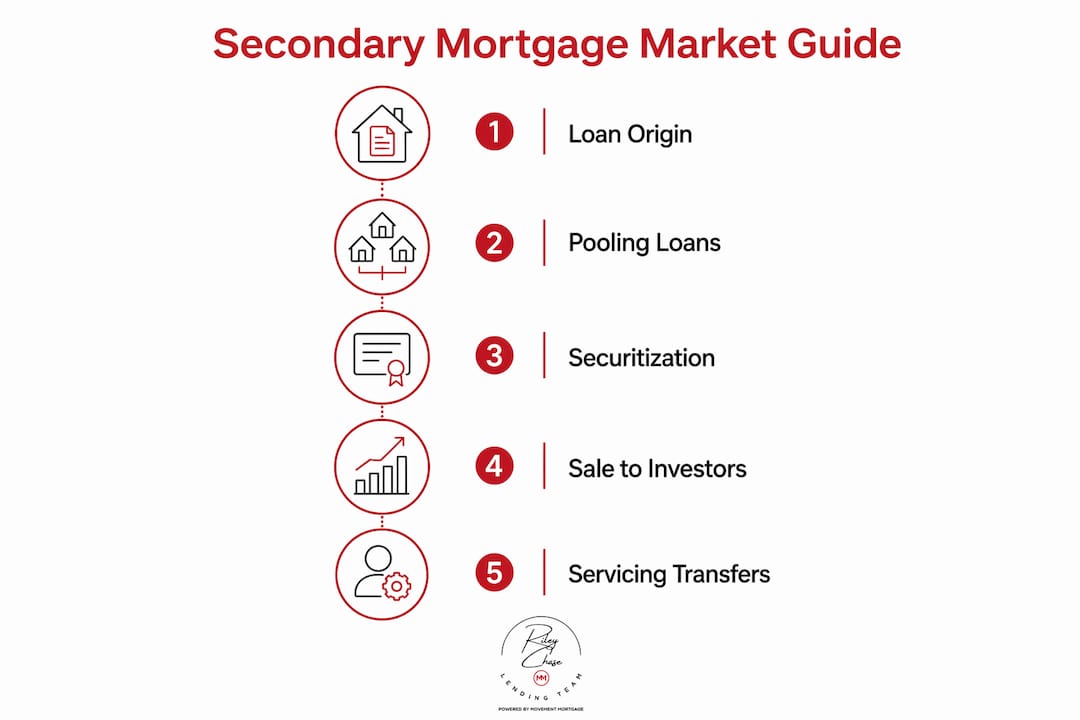
How a mortgage moves from your closing table to global investors
Understanding the step-by-step flow helps you see exactly where your loan goes and why that matters for your rate, your servicer, and your options.
-
You apply and get approved. A lender (a bank, credit union, or mortgage company) originates your loan in the primary market, evaluating your credit, income, and the property.
-
The lender funds your loan. At closing, the lender advances the full purchase amount. That capital is now tied up in your mortgage.
-
Underwriting and eligibility are confirmed. The lender checks whether your loan meets agency standards (conforming) or falls outside them (nonconforming). This classification determines where the loan can be sold.
-
The lender sells the loan. Most lenders sell loans quickly, either directly to Fannie Mae or Freddie Mac, or to an aggregator who accumulates loans from multiple originators. The lender receives cash and can immediately make new loans.
-
Loans are pooled. The buyer groups hundreds or thousands of similar mortgages together. A typical conforming 30-year fixed loan, for example, gets pooled with other conforming loans of similar terms and credit profiles.
-
An MBS is created and sold. The pool is packaged into a mortgage-backed security. Fannie Mae or Freddie Mac guarantees payments on agency MBS; Ginnie Mae provides a full government guarantee on MBS backed by FHA and VA loans. The MBS is then sold to investors.
-
Investors receive monthly payments. Pension funds, insurance companies, and international investors buy MBS for steady income. Each month, borrower payments flow through a servicer to those investors.
-
A servicer handles your account. The servicer collects your payment, manages escrow, and handles customer service. The servicer may or may not be the lender who originated your loan.
Pro Tip: Ask your lender at closing whether they will retain servicing or transfer it. You’re entitled to notice before any servicing transfer, and your loan terms — rate, balance, payment schedule — cannot change when it happens.

Who the main participants are and what each one does
Several distinct players operate in this market, and knowing who they are helps you ask better questions and understand the notices you receive.
Originators are the lenders you work with directly: banks, credit unions, and independent mortgage companies. They evaluate your application, fund your loan, and typically sell it shortly after closing. Their profit comes from origination fees and the spread between what they lend and what they receive when they sell.
Fannie Mae (Federal National Mortgage Association) buys conforming loans that meet FHFA-regulated standards, bundles them into MBS, and sells those securities to investors. Fannie Mae guarantees that investors receive timely principal and interest payments even if borrowers default.

Freddie Mac (Federal Home Loan Mortgage Corporation) does essentially the same job as Fannie Mae, operating as a parallel GSE (government-sponsored enterprise). Both Fannie and Freddie are regulated by the FHFA and focus on conventional conforming loans.
Ginnie Mae (Government National Mortgage Association) is different in one key way: it provides a full faith and credit guarantee of the U.S. government on MBS backed exclusively by FHA, VA, and USDA loans. Ginnie Mae does not buy or sell loans; it guarantees the securities.
Aggregators are financial institutions that purchase loans from multiple originators, pool them, and either hold them or pass them to a GSE for securitization. They smooth out volume differences between small lenders and the large securitization pipeline.
Servicers collect your monthly payment, manage your escrow account, and handle loss mitigation if you run into trouble. When a loan is sold, the servicing rights are often sold separately. Loan terms do not change when servicing transfers; only the address where you send your payment changes.
Investors are the end buyers of MBS: pension funds, insurance companies, sovereign wealth funds, and mutual funds. Their appetite for MBS directly influences mortgage pricing.
Where to check who owns your loan: Fannie Mae and Freddie Mac each offer free online lookup tools on their websites. For FHA and VA loans, HUD and the VA maintain servicer contact resources. Knowing your loan’s owner can matter if you need to request a modification or understand your options during hardship.
Why the secondary market matters to you — benefits and real trade-offs
The secondary market creates genuine advantages for homebuyers, but it also introduces dynamics worth understanding before you sign.
Benefits:
- Lower, more stable rates. Investor competition for MBS drives down the cost of mortgage capital. More buyers for MBS means lenders can offer lower rates than they could if they had to fund every loan from deposits alone.
- 30-year fixed-rate mortgages exist because of this market. Securitization allows originators to avoid holding long-duration loans on their balance sheets, which is the only reason most lenders offer 15- and 30-year fixed products at all.
- Wider credit access. Selling loans to the secondary market replenishes lender capital and frees it for new lending, which means more borrowers get served, including first-time buyers and those in smaller markets.
- Standardized underwriting. Because loans must meet agency guidelines to be sold, underwriting criteria are consistent and transparent. You know what to expect, and lenders can’t arbitrarily change the rules mid-process.
- Refinancing flexibility. A liquid secondary market means lenders can quickly originate refinance loans and sell them, keeping refinance rates competitive when rates drop.
Trade-offs:
- Servicer changes can be disorienting. Your loan may be sold multiple times, and your servicer can change with little notice. The law requires written notice before a transfer, but it can still catch borrowers off guard.
- Tighter credit when investor demand falls. If investors pull back from MBS (as happened in 2008 and briefly in 2020), lenders tighten underwriting standards quickly. Borrowers on the margins of eligibility feel this first.
- Lender incentive shifts. When lenders sell loans rather than hold them, their profit comes from origination volume rather than long-term loan performance. Post-2008 reforms addressed the worst abuses, but it’s worth understanding that your lender’s incentives may not perfectly align with your long-term interests.
Pro Tip: If you’re refinancing, check whether your current servicer offers a streamline option. Because they already hold your loan data, the process can be faster and sometimes cheaper than going to a new lender.
Agency MBS, Ginnie Mae securities, and private-label MBS: what’s the difference?
Not all mortgage-backed securities carry the same guarantee, and that distinction flows directly back to borrower eligibility and pricing.
Agency MBS are issued and guaranteed by Fannie Mae or Freddie Mac. They back conforming loans: conventional mortgages that meet FHFA loan limits and credit standards. Because Fannie and Freddie guarantee timely payment, agency MBS carry very low credit risk for investors, which keeps borrowing costs lower for conforming borrowers. If you’re taking out a fixed-rate mortgage within conforming loan limits, your loan will likely end up in an agency MBS.
Ginnie Mae securities carry an explicit full faith and credit guarantee of the U.S. government. They are backed exclusively by FHA, VA, and USDA loans. Because the government guarantee is direct and unconditional, Ginnie Mae MBS are considered the safest mortgage securities available. This guarantee is what makes FHA and VA loans accessible to borrowers with lower down payments or less-than-perfect credit.
Private-label securities (PLS) are issued by banks and other financial institutions without any agency or government guarantee. They typically back nonconforming loans — jumbo mortgages, loans with unusual characteristics, or loans that don’t meet GSE standards. Because investors bear the full credit risk, PLS carry higher yields and stricter investor scrutiny. Borrowers with jumbo loans or non-QM products often find their loans in private-label pools, which can mean slightly different pricing dynamics.
- Agency MBS: conforming loans, GSE guarantee, lower investor risk, broadly available to most buyers
- Ginnie Mae: FHA/VA/USDA loans, U.S. government guarantee, lowest credit risk, supports lower-income and veteran borrowers
- Private-label MBS: nonconforming/jumbo loans, no guarantee, higher investor risk premium, less standardized underwriting
Commercial mortgage-backed securities (CMBS) are a separate category covering commercial real estate loans, not residential mortgages.
How investor demand and GSE actions shape the rates you’re quoted
Mortgage rates don’t move in isolation. They’re directly tied to what investors are willing to pay for MBS and what GSEs charge to guarantee them.
When investor appetite for MBS is strong, lenders can sell loans at favorable prices, which lets them offer lower rates to borrowers. When demand weakens — because of economic uncertainty, rising competing yields, or credit concerns — lenders must offer higher rates to attract buyers for their loans. Investor demand affects mortgage pricing in real time, which is why rates can move daily even when the Federal Reserve hasn’t changed its benchmark.
According to FHFA, three-quarters of single-family loan volume is now funded through MBS, compared with three-fifths in 2001. That growing share means the secondary market’s health is more tightly linked to your rate quote today than it was a generation ago. For context, Bipartisan Policy Center analysis found that roughly 59–60% of mortgages were sold to third parties in some periods, with securitization driving the majority of that funding.
GSE actions add another layer. When Fannie Mae or Freddie Mac increase their guarantee fees (called “g-fees”), lenders pass those costs to borrowers as slightly higher rates. When the Federal Reserve has purchased MBS directly, as it did during and after the 2008 crisis and again in 2020, that additional demand compressed spreads and temporarily pushed rates lower. Those interventions are policy tools, not permanent features, and rates normalize when the Fed steps back. You can track how current rate movements connect to these dynamics on the Rileychase blog.
A brief history: how the secondary market got here and what 2008 changed
The secondary mortgage market didn’t emerge from thin air. Its structure reflects decades of policy decisions, crises, and reforms.
The 1930s foundation. The modern secondary market traces its roots to the Great Depression, when widespread mortgage defaults collapsed the housing finance system. Congress created Fannie Mae in 1938 to buy FHA-insured loans from lenders, giving them capital to make new loans. Freddie Mac followed in 1970 to create competition and expand the market for conventional loans. Ginnie Mae was established in 1968 to guarantee securities backed by government-insured loans.
The securitization era. Through the 1980s and 1990s, MBS became a mainstream investment product. Private-label securitization grew rapidly alongside agency activity, and the market expanded to include increasingly complex loan types. By the mid-2000s, private-label MBS backed by subprime and Alt-A loans had grown to a significant share of originations.
The 2008 crisis. When housing prices fell and default rates spiked, private-label MBS collapsed in value. Fannie Mae and Freddie Mac, which had also expanded into riskier products, required a federal conservatorship in September 2008. The FHFA took over as conservator and has overseen both GSEs since. The crisis exposed how poorly understood the credit risk in many MBS pools had been.
Post-2008 reforms. The Dodd-Frank Act of 2010 introduced risk-retention requirements (lenders must keep “skin in the game” for certain loan types), stronger underwriting standards, and expanded CFPB oversight. FHFA tightened GSE eligibility criteria and capital requirements. The result for borrowers: stricter documentation requirements, clearer loan disclosures, and more consistent underwriting.
For current policy and rule changes, the FHFA and HUD publish official guidance that supersedes anything you read in a general article, including this one.
Practical steps to take when talking to your lender
Knowing how the secondary market works is useful. Knowing what to ask your lender because of it is what actually protects you.
-
Ask whether the lender typically sells loans. Most do, but some portfolio lenders hold loans in-house. Knowing this upfront helps you understand what to expect after closing.
-
Ask who will service the loan. The originating lender and the servicer are often different entities. Get the servicer’s name and contact information before closing if possible.
-
Confirm whether your loan is conforming. A conforming loan meets FHFA loan limits and GSE standards. Nonconforming loans (jumbo, non-QM) may have different pricing and fewer secondary-market buyers, which can affect your rate.
-
Check agency eligibility for your loan type. If you’re using an FHA or VA loan, your MBS will be Ginnie Mae-backed. If you’re using a conventional loan within limits, expect Fannie or Freddie. Understanding this helps you verify your loan’s guarantee structure.
-
Review the Loan Estimate carefully. The Loan Estimate document itemizes fees, rate, and loan terms. Compare it line by line across lenders.
-
Get pre-approved before rates shift. When investor demand tightens, lenders raise standards quickly. A current pre-approval with organized documentation keeps you positioned to move fast. The mortgage approval process guide from Rileychase walks you through each step.
-
Understand your rate lock. A rate lock protects you from market moves during the closing period. Ask how long the lock lasts, what it costs to extend, and what happens if your closing is delayed.
-
Use lookup tools to verify loan ownership. After closing, you can use Fannie Mae’s and Freddie Mac’s free lookup tools to confirm who owns your loan. For FHA loans, HUD’s servicer resources provide similar information.
Pro Tip: If market conditions are volatile, ask your lender about a float-down option on your rate lock. It lets you capture a lower rate if rates drop before closing, without losing your locked rate if they rise.
Key Takeaways
The secondary mortgage market is the engine behind mortgage availability in the U.S., connecting local lenders to global capital through GSEs, MBS, and a continuous cycle of loan sales and reinvestment.
| Point | Details |
|---|---|
| Scale of the market | Three-quarters of single-family loan volume is funded through MBS sales, per FHFA data. |
| GSEs are central | Fannie Mae, Freddie Mac, and Ginnie Mae guarantee most MBS and keep capital flowing to lenders. |
| Investor demand drives rates | When MBS demand is strong, rates fall; when it weakens, lenders tighten standards and raise rates. |
| Servicer changes are normal | Your loan terms stay the same if your servicer changes; only the payment address shifts. |
| Rileychase guides you through it | The Rileychase team helps borrowers understand loan types, pre-approval, and what to expect when loans are sold. |
What I’ve seen working with borrowers on this
Most borrowers I work with are surprised to learn that their loan will almost certainly be sold within weeks of closing. The secondary market feels abstract until you get a letter saying your servicer has changed and you’re not sure if your rate went up. It didn’t. Your terms are locked. But that confusion is avoidable with the right preparation.
What I find underappreciated is how directly investor behavior in the MBS market translates to the rate quote you receive on a Tuesday afternoon. Lenders aren’t setting rates arbitrarily. They’re pricing based on what they can sell your loan for that day. When spreads widen because investors are nervous, your rate goes up even if the Fed hasn’t moved. That’s the secondary market at work, and understanding it gives you a real edge when timing a purchase or refinance.
The 2008 crisis permanently changed the rules, and the post-reform market is genuinely safer for borrowers. Underwriting standards are more consistent, disclosures are clearer, and the GSE conservatorship has kept the system stable. That doesn’t mean the market is risk-free, but it does mean the guardrails are stronger than they were.
Ready to put this knowledge to work?
Understanding how the secondary mortgage market works is the first step. The next one is finding the right loan for your situation and getting pre-approved before market conditions shift.

The Rileychase team specializes in helping buyers navigate exactly this: which loan type fits your goals, whether conforming or nonconforming, fixed or adjustable, FHA or conventional. We walk you through what happens after closing, including servicer expectations, and we keep the process transparent from application to funding. When investor-driven tightening happens, prepared borrowers with strong pre-approvals move faster and with more confidence.
Start your pre-approval today, or browse loan options to see which products fit your budget and timeline. If you’re comparing lenders, this guide to first-time mortgage providers offers a useful external perspective on what to look for.
Authoritative sources and further reading
These primary sources are where the facts in this article come from. Bookmark the ones most relevant to your situation.
- FHFA — Mortgage Market Note 08-3: A Primer on the Secondary Mortgage Market: The most detailed government-sourced explanation of market structure, MBS mechanics, and funding shares. Best for researchers and policy-minded readers.
- FHFA — Conforming Loan Limits: Official annual loan limits that determine whether your mortgage is conforming. Essential for borrowers near the limit.
- Freddie Mac — How the Secondary Mortgage Market Works: Plain-language explanation from one of the two main GSEs. Good starting point for borrowers who want the basics from a primary source.
- Fannie Mae: Offers loan lookup tools and borrower resources, including information on loan ownership and servicer contacts.
- Ginnie Mae: Official source for information on government-backed MBS and FHA/VA loan securitization.
- Bipartisan Policy Center — The Role of the Secondary Market: Policy-focused analysis of how the secondary market supports origination volume and what reform options look like. Best for readers interested in housing policy.
- Congress.gov — An Overview of the Housing Finance System in the United States: Congressional Research Service report covering primary and secondary markets, GSE roles, and MBS types in depth. Authoritative and comprehensive.
- Investopedia — The Secondary Mortgage Market Explained: Accessible definitions and explanations for borrowers who want a clear overview without policy depth.
- Bankrate — What Is the Secondary Mortgage Market?: Consumer-focused explainer covering investor behavior, rate connections, and borrower implications.
Recommended

Related Posts