
Discover why investor mortgage rates are higher. Learn about the risks that affect loan costs and how to negotiate better terms.
Shorten Your Mortgage Term: Refinancing Guide for Homeowners
Yes, you can shorten your mortgage term by refinancing into a shorter-term loan, and the payoff is real: less total interest paid and faster equity growth. Here are the two primary paths:
- Refinance into a shorter term (e.g., swap a 30-year for a 15-year or 20-year loan), which locks in a new, compressed repayment schedule and often a lower interest rate.
- Refinance now and apply extra principal payments, which gives you flexibility to pay down faster without the contractual obligation of a shorter term.
Both approaches trade a higher monthly payment for long-term interest savings. Two gatekeepers determine whether either path is worth it: your break-even point (how many months until closing costs are recovered) and whether you can genuinely afford the higher payment without straining your household budget.
Table of Contents
- How does shortening your mortgage term affect monthly payments and interest?
- What does refinancing to a shorter term actually cost you?
- When does refinancing to a shorter term actually make sense?
- What do lenders look at, and how long does refinancing take?
- How to refinance to a shorter term, step by step
- Concrete scenarios: 30→15, 30→20, and paying extra monthly
- Key Takeaways
- The case for honest math over optimistic projections
- Rileychase is ready to help you shorten your mortgage term
- Authoritative resources and calculators to use next
How does shortening your mortgage term affect monthly payments and interest?
When you shorten a mortgage term, you compress the repayment schedule. Principal gets paid back faster, which means the loan balance shrinks more quickly and interest has less time to accumulate. As loan term research from Experian confirms, shorter-term loans generally reduce total interest paid, and lenders often price them with slightly lower rates because the credit risk is smaller over a shorter horizon.
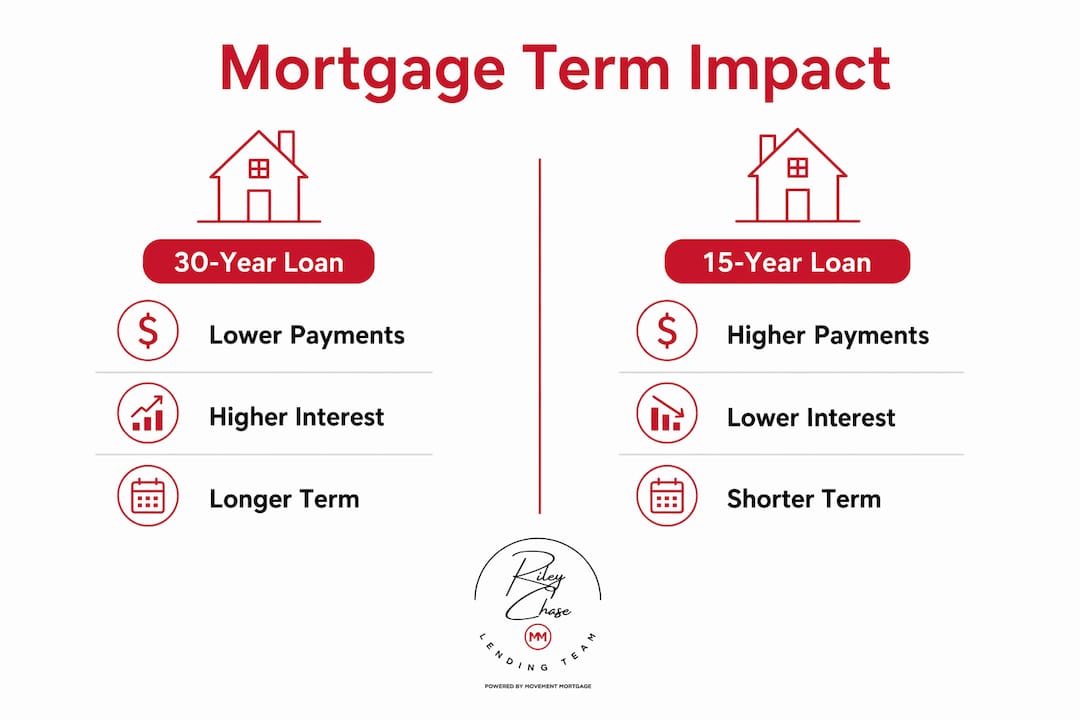
The trade-off is straightforward: a lower total cost in exchange for a higher monthly payment. Understanding why requires a quick look at amortization. Early in a 30-year loan, the vast majority of each payment goes toward interest. A 15-year loan forces more principal into every payment from day one, which accelerates equity and cuts the interest bill dramatically.
Here is a side-by-side comparison at illustrative rates and a hypothetical $300,000 starting balance, showing how shorter terms typically increase monthly payments but reduce total interest paid over the life of the loan. Actual rates and payments vary by lender, credit profile, and market conditions.

Worked example — 30-year to 15-year refinance: Starting with a hypothetical $300,000 balance, a 30-year loan at an illustrative rate has a lower monthly payment but significantly more total interest than a 15-year loan at a slightly lower hypothetical rate, which increases the monthly payment but dramatically reduces total interest paid. This example shows potential savings and payment differences; actual figures will depend on current rates and terms.
Pro Tip: Rate differences between a 30-year and a 15-year loan may look small on paper, but they compound significantly over time. Even a half-point rate reduction on a shorter term can add thousands of dollars to your total savings. Always compare the full APR, not just the headline rate, when evaluating offers.
What does refinancing to a shorter term actually cost you?
Refinancing is not free, and those upfront costs are what make the break-even calculation so important. Typical closing costs fall into a few identifiable buckets:
- Appraisal fee: Usually $300–$600, required to confirm the home’s current market value.
- Title search and title insurance: Verifies ownership history and protects the lender against title disputes.
- Lender origination fee: Covers underwriting and processing; often expressed as a percentage of the loan amount or a flat fee.
- Prepaid items: Homeowners insurance, property taxes, and prepaid mortgage interest due at closing.
- Recording fees and transfer taxes: Vary by state and county.
The Federal Reserve’s consumer refinancing guide is a reliable starting point for understanding what each fee category covers and what questions to ask your lender.
The break-even formula:
Worked example: Suppose your refinance generates $5,000 in closing costs and your new monthly payment is $617 higher than your current one. Wait — in a term-shortening refinance, the monthly payment typically goes up, not down. So the “savings” here is the monthly interest reduction, not a lower payment. A cleaner way to frame it: if your new 15-year payment is $617 more per month but you save roughly $248,000 in total interest, you need to stay in the home long enough for those cumulative interest savings to outweigh the closing costs. Divide $5,000 by the monthly interest savings (the portion of the payment difference attributable to interest reduction rather than accelerated principal) to find your break-even in months. As Redfin’s refinancing guidance notes, you must remain in the home past that calculated break-even to realize a net benefit.
A few variations worth knowing:
- No-closing-cost refinance: Fees are rolled into a higher rate or added to the loan principal. This lowers upfront cash but changes the break-even math and reduces long-term savings.
- Cash-out refinance: Pulling equity out while shortening the term increases the loan balance and raises the break-even threshold.
- Time-to-move factor: If you plan to sell within five years, always compare your break-even timeline against your expected move date before committing.
You can explore the full range of refinancing options to see how each structure affects your total cost.
When does refinancing to a shorter term actually make sense?
Not every homeowner should rush into a shorter-term refinance, even when the math looks attractive. Here is a practical decision checklist:
Affordability test:
- Can you cover the higher monthly payment comfortably on your current income?
- Do you have an emergency fund covering 3–6 months of expenses? As Earnest’s payoff-timeline guidance recommends, testing income stability and emergency fund sufficiency before committing to higher payments is a critical step.
- Would the higher payment leave enough room for retirement contributions, other savings, and unexpected costs?
Stay-duration test:
- Do you plan to stay in the home past your break-even point?
- If you might move in three to five years, the closing costs may never be recovered.
Credit and LTV checkpoints:
- A credit score of 620 is a common minimum for conventional refinances, but scores above 740 typically unlock the best rates.
- Loan-to-value (LTV) ratio matters: most lenders prefer LTV at or below 80% to avoid private mortgage insurance.
- Debt-to-income (DTI) ratio generally should stay below 43% to qualify, though some lenders allow higher with compensating factors.
Red flags that should give you pause:
- Recent job change or income instability
- Plans to sell or relocate before the break-even point
- Prepayment penalties on your current loan that would add to closing costs
- Very high closing costs relative to your monthly interest savings
- High-interest unsecured debt (credit cards, personal loans) that should be paid down first, since prioritizing that debt often delivers a better financial return than locking into a higher mortgage payment
Questions to ask any lender:
- What is the full APR, not just the interest rate?
- What are the total closing costs, itemized?
- Is there a prepayment penalty on the new loan?
- Can the loan be recast if my financial situation changes?
Knowing when it is the right time to refinance depends on your personal timeline as much as the rate environment.
What do lenders look at, and how long does refinancing take?

Lenders evaluate several factors when you apply to refinance to a shorter term. Understanding these upfront helps you prepare and avoid surprises.
Lender criteria:
- Credit score: Higher scores mean better rates; most conventional lenders want 620 or above, with the best pricing reserved for 740+.
- Debt-to-income ratio (DTI): Lenders calculate your total monthly debt payments as a percentage of gross monthly income.
- Loan-to-value ratio (LTV): Lower LTV signals more equity and less risk; below 80% avoids PMI.
- Employment and income: Two years of stable employment history is the standard benchmark.
- Property condition: The appraisal must support the loan amount.
Documents to gather before you apply:
- Last two pay stubs
- W-2s for the past two years
- Federal tax returns (two years)
- Two to three months of bank statements
- Current mortgage statement showing balance and payment history
- Homeowners insurance declarations page
Typical timeline: Most refinances close in 30–45 days from application. Delays commonly come from appraisal scheduling, title issues, or incomplete documentation. Reviewing how to prepare for a mortgage refinance before you apply can meaningfully cut that timeline.
What speeds things up or slows them down:
- Clean title with no liens: faster
- Self-employment or variable income: slower (more documentation required)
- Recent cash-out refinance on the same property: may trigger additional review
- Condo or co-op property: often requires HOA documentation and additional lender review
How to refinance to a shorter term, step by step
Follow these steps to move from evaluation to closing with confidence.
-
Run your current-loan snapshot. Pull your most recent mortgage statement and note your remaining balance, current interest rate, monthly principal and interest payment, and remaining term. This is your baseline for every comparison you will make.
-
Shop rates and get multiple quotes. Contact at least three lenders and request quotes for both a 15-year and a 20-year refinance on the same loan amount. APR and fees determine the loan’s true cost, not just the interest rate, so ask for the full Loan Estimate form from each lender.
-
Calculate break-even and monthly payment changes. For each candidate term, compute the break-even in months using the formula from the costs section. Compare that number against how long you realistically plan to stay in the home.
-
Choose your lender and lock your rate. Once you have selected the best offer, lock the rate in writing. Rate locks typically run 30–60 days. Confirm whether the lock is free to extend if closing is delayed.
-
Complete underwriting and close. Submit your documentation promptly, respond to any lender requests within 24–48 hours, and schedule the appraisal as soon as it is offered. Review the Closing Disclosure carefully before signing.
Pro Tip: A no-closing-cost refinance sounds appealing, but rolling fees into a higher rate means you pay interest on those costs for the life of the loan. If you plan to stay in the home for more than five to seven years, paying closing costs upfront almost always saves more money. Run the numbers both ways before deciding.
When comparing offers, look beyond the headline rate. Check whether the lender allows recasting (recalculating your payment after a large principal payment without a full refinance), whether there are prepayment penalties, and whether the loan is a fixed-rate product for the full term. If you are also thinking about debt consolidation or a renovation, be careful not to let those goals push you toward a cash-out refinance that increases your balance and undermines the term-shortening objective.
Concrete scenarios: 30→15, 30→20, and paying extra monthly
The table below uses a $300,000 starting balance to compare three realistic paths. Rates are illustrative.
| Scenario | Monthly payments | Total interest | Break-even |
|---|---|---|---|
| Stay on 30-year loan at a given rate | Lower monthly payment | Higher total interest | N/A |
| Refinance to shorter terms at lower rates | Higher monthly payments | Lower total interest | Depends on closing costs and savings |
| Stay on 30-year, pay extra principal | Requires additional monthly cash | Reduces total interest compared to staying the course | No closing costs |
These are illustrative examples to compare how shortening your mortgage term or paying extra principal can impact payments and interest. Actual outcomes vary based on your loan specifics.
A few things stand out when you look at these side by side:
- The 30→15 refinance delivers the largest total interest savings but requires the highest payment commitment. It suits homeowners with stable, growing income who plan to stay long-term and want the discipline of a fixed payoff date.
- The 30→20 refinance is a middle path: meaningfully lower total interest than staying on a 30-year, with a more manageable payment increase. It works well for homeowners who want to shorten the term but are not ready for the full 15-year payment jump.
- Paying extra monthly without refinancing avoids closing costs entirely, which is a real advantage. The total interest savings are slightly less than a formal 15-year refinance (because you likely keep the original higher rate), but the flexibility is valuable. If income drops, you can stop the extra payments without penalty. Extra mortgage payments are worth modeling before you commit to a full refinance.
One nuance: recasting is a lesser-known option worth asking about. If you make a large lump-sum principal payment, some lenders will recast the loan, recalculating your monthly payment on the reduced balance without requiring a full refinance. It does not change the term on its own, but combined with higher monthly contributions, it can accelerate payoff with minimal paperwork.
Key Takeaways
Refinancing to a shorter mortgage term saves the most interest when you can afford the higher payment, plan to stay past the break-even point, and lock in a lower rate than your current loan.
| Point | Details |
|---|---|
| Interest savings are substantial | A refinance from a 30-year to a 15-year term on a sizeable loan balance can save substantial total interest at illustrative rates. |
| Higher monthly payment is the trade-off | Shortening from a 30- to a 15-year term increases the monthly principal and interest payment significantly, reflecting the faster repayment schedule. |
| Break-even is the key test | Divide total closing costs by monthly interest savings to find how many months until the refinance pays off. |
| Affordability and stability come first | Confirm a 3–6 month emergency fund and stable income before committing to a higher payment. |
| Rileychase can run the numbers with you | Rileychase provides personalized rate quotes, break-even analysis, and loan options counseling to help you choose the right term. |
The case for honest math over optimistic projections
Most homeowners who ask about shortening their mortgage term are motivated by the right instinct: they want to own their home outright and stop paying interest they do not have to pay. That instinct is sound. Where the process goes sideways is when the excitement of a large total-interest savings number overrides a clear-eyed look at the monthly budget.
The scenario that concerns me most is the homeowner who stretches into a 15-year payment, then faces an income disruption or an unexpected expense and has no financial cushion. A mortgage is not flexible. Missing payments has consequences that a slightly longer loan term never would have caused. The 20-year refinance is genuinely underrated in this conversation. It delivers meaningful interest savings compared to a 30-year loan, requires a more moderate payment increase, and gives you room to make extra payments voluntarily when cash flow allows.
The other thing worth saying plainly: the current rate environment matters. If your existing loan is already at a rate close to or below what lenders are quoting today, the math on a term-shortening refinance may not work in your favor right now. In that case, making disciplined extra principal payments on your current loan can accomplish much of the same goal without closing costs or a rate increase. The right answer depends on your specific numbers, not a general rule.
Rileychase is ready to help you shorten your mortgage term
Paying off your home faster is one of the most direct paths to financial freedom, and Rileychase makes the math clear before you commit to anything. Rather than handing you a generic rate quote, the team walks you through a personalized break-even analysis, compares 15-year and 20-year options side by side, and helps you stress-test the higher payment against your actual household budget.

Here is what you get when you work with Rileychase on a term-shortening refinance: a full closing-cost breakdown upfront, honest guidance on whether the numbers work for your timeline, help gathering and organizing your documentation, and loan options counseling that covers fixed-rate products, no-closing-cost structures, and alternatives like extra payments or recasting. No surprises at the closing table.
Ready to see what a shorter term looks like for your specific loan? Start your refinance inquiry today, or explore your loan options to find the right product for your goals.
Authoritative resources and calculators to use next
Use these trusted sources to run your own numbers and verify guidance before meeting with a lender.
- Federal Reserve — A Consumer’s Guide to Mortgage Refinancings: Covers the full refinancing process, fee types, and how to evaluate whether refinancing makes financial sense. Start here for regulatory context.
- Consumer Financial Protection Bureau (CFPB): Offers mortgage calculators, complaint resources, and plain-language explanations of loan terms and closing costs.
- IRS — Mortgage Interest Deduction: Refinancing to a shorter term reduces total interest paid, which also reduces the mortgage interest deduction over time. Check IRS guidance on deductibility limits for your situation.
- HUD — Housing Counseling Agencies: HUD-approved housing counselors can review your refinance options at low or no cost, which is especially useful if you are unsure whether the numbers work for your budget.
- FTC — Free Financial Reports: Access free credit reports and understand how your credit profile affects the rates lenders will offer you.
- Washington State DFI — Mortgage Refinancing Basics: A clear, consumer-friendly overview of why homeowners refinance and what to expect from the process.
- CFPB Mortgage Calculator: Use the CFPB’s online tools to compare monthly payments across different terms and rates. Screenshot your results and bring them to lender conversations so you can ask informed questions about how their quotes compare.
A note on calculators: For break-even analysis, use a calculator that lets you input total closing costs and monthly payment difference separately. For monthly payment comparisons across terms, the CFPB and many lender sites offer side-by-side tools. Saving or screenshotting your results before meeting with a lender gives you a concrete reference point and makes the conversation more productive.
This article is general information, not professional financial or legal advice. Confirm current rates, fees, and eligibility requirements with a qualified mortgage professional or the relevant primary source for your specific situation.
Recommended

Related Posts