
Discover why investor mortgage rates are higher. Learn about the risks that affect loan costs and how to negotiate better terms.
Mortgage Underwriting Process Walkthrough: 2026 Guide
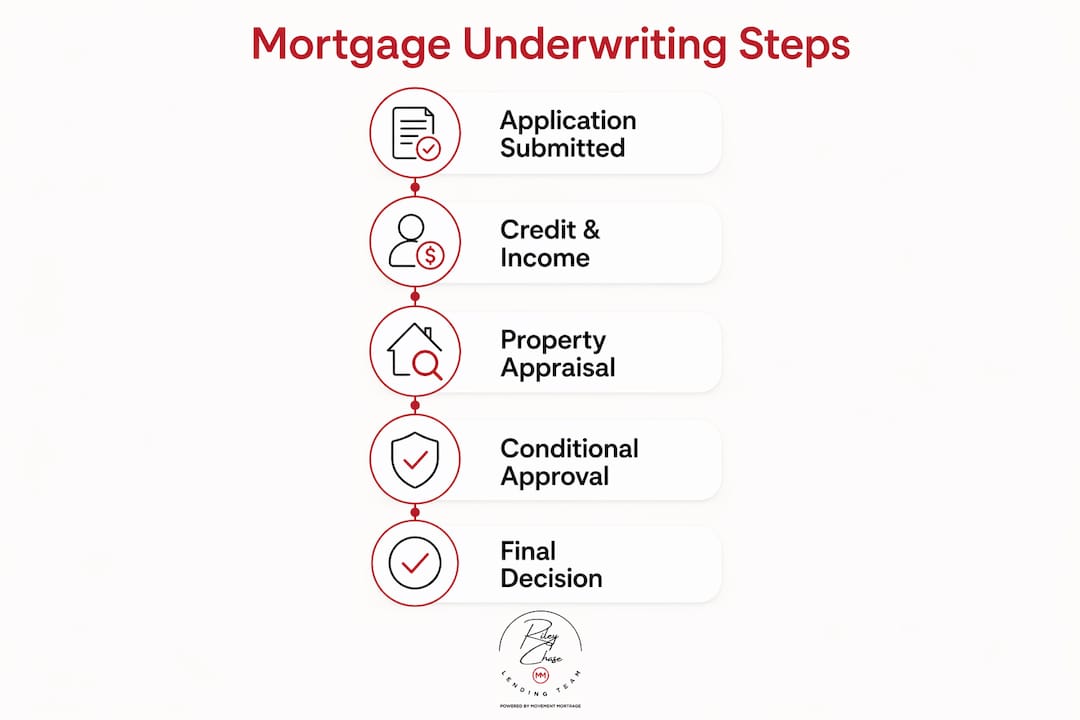
Mortgage underwriting is the lender’s formal review of your finances and the property you want to buy, and it’s the step that determines whether your loan gets approved. The underwriter examines your credit history, income, assets, and the home’s appraised value to confirm you can repay the loan and that the property supports the amount being borrowed. Think of it as the lender’s due diligence before committing hundreds of thousands of dollars. Understanding each stage of this process puts you in control, so you know exactly what to expect and how to prepare.
Here’s what underwriters typically review:
- Credit reports and scores to assess your borrowing history and payment reliability
- Income and employment records including W-2s, pay stubs, and tax returns
- Asset statements covering bank accounts, retirement funds, and down payment sources
- Debt-to-income (DTI) ratio to confirm your monthly obligations stay within acceptable limits
- Property appraisal to verify the home’s market value supports the loan amount
- Loan-to-value (LTV) ratio to measure lender risk relative to the property’s worth
Step 1: Submitting your mortgage application and gathering documents
Your mortgage application is the foundation of the entire underwriting review. Every piece of information you provide gets verified, so accuracy and completeness matter from the start. Your loan officer guides you through the Uniform Residential Loan Application (Form 1003), which captures your personal details, employment history, income, assets, and the property you intend to purchase.
Before your file moves to underwriting, you’ll need to supply a standard set of documents:
- W-2s and tax returns from the past two years
- Recent pay stubs covering at least 30 days
- Bank and investment account statements from the past 60–90 days
- Government-issued photo ID and Social Security number
- Signed purchase contract for the property
- Proof of any additional income such as rental income or alimony
Once your application is submitted, your loan officer issues a Loan Estimate within three business days. This document outlines your projected interest rate, monthly payment, and closing costs, giving you a clear picture of the loan terms before underwriting begins. Getting pre-approved for a home loan before you start house hunting puts you even further ahead, since much of this documentation is already in order.
Step 2: How the underwriter reviews your credit, income, and assets
This is where the real scrutiny happens. The mortgage underwriter is the final decision-maker, and their job is to verify every financial claim in your file. Underwriters are deliberately walled off from the sales side of the lending operation, so their review is purely about risk, not about closing deals.
Underwriters conduct an in-depth review of your credit history, employment length, income consistency, and the origin of large deposits in your bank accounts. Here’s what they examine:
- Credit score and report: Late payments, collections, and high balances all factor into the risk assessment.
- DTI ratio: Most conventional loans require a DTI at or below 43–45%, though guidelines vary by loan type.
- Employment verification: Lenders confirm your job title, tenure, and income directly with your employer.
- Self-employment income: If you’re self-employed, expect to provide two years of business tax returns and a profit-and-loss statement.
- Asset verification: Underwriters confirm you have enough funds for the down payment, closing costs, and reserves. They also require down payment source verification to confirm the funds aren’t an undisclosed loan.
- LTV ratio: A $380,000 loan on a $400,000 home produces a 95% LTV. Loans above 80% LTV typically require private mortgage insurance (PMI).
Automated underwriting systems (AUS) like Fannie Mae’s Desktop Underwriter or Freddie Mac’s Loan Product Advisor run your data through algorithms to produce an initial risk recommendation. Automated systems speed the process, but manual underwriting takes over for complex financial profiles, self-employed borrowers, or situations where the automated result doesn’t match the supporting documents.
Step 3: What the property appraisal means for your loan
The appraisal is the lender’s way of confirming the home is worth what you agreed to pay. A certified, independent appraiser visits the property and compares it to recent sales of similar homes in the area, factoring in square footage, condition, location, and features. The lender orders the appraisal, and you typically pay for it upfront, with fees generally ranging from $300 to $500 for a standard single-family home, though costs vary by market.

The appraisal directly shapes your loan amount and LTV ratio. If the home appraises at or above the purchase price, underwriting moves forward without issue. If it comes in low, the lender will only finance based on the appraised value, not the contract price. That gap becomes your problem to solve.
When an appraisal falls short, your options are:
- Renegotiate the purchase price with the seller to match the appraised value
- Pay the difference in cash to cover the gap between appraised value and purchase price
- Request a reconsideration of value if you believe the appraiser missed comparable sales
- Walk away if your purchase contract includes an appraisal contingency
A low appraisal is one of the most stressful underwriting hurdles, but it’s not uncommon. Going in with a realistic sense of the local market helps you respond quickly if it happens.
Step 4: Conditional approval and how to clear your conditions fast
Conditional approval is the most common underwriting outcome, and it is not a denial. It means your loan is approved in principle, but the underwriter needs a few more items before giving the final green light. Most files come back with at least some conditions, so receiving one is completely normal.
Typical conditions include:
- An updated pay stub or bank statement dated within 30 days
- A letter explaining a recent credit inquiry or a gap in employment
- Proof of homeowners insurance on the new property
- Documentation resolving a collection account or disputed item
- A gift letter if part of your down payment came from a family member
A suspension status is different and more urgent. It means the underwriter can’t proceed because critical information is missing entirely, such as IRS tax transcripts that haven’t arrived or bank statements with missing pages. A suspension eats into your timeline and can threaten your rate lock or closing date if it drags on.
Pro Tip: Create a dedicated folder (digital or physical) for every document you submit. When a condition request comes in, you can respond within hours instead of days. Speed here directly protects your closing date.

Step 5: The final underwriting decision and what happens at closing
After all conditions are cleared, the underwriter issues one of four decisions: clear to close, conditional approval (with remaining items), suspension, or denial. Clear to close is the goal, and it means the underwriter has signed off on your entire file.
Once you receive clear to close:
- Your lender issues a Closing Disclosure at least three business days before closing, detailing your final loan terms, monthly payment, and itemized closing costs.
- You do a final walkthrough of the property to confirm its condition hasn’t changed since the appraisal.
- You bring certified funds or arrange a wire transfer for your down payment and closing costs.
- You sign the closing documents, which typically takes 60–90 minutes at a title company or attorney’s office.
- Funds are disbursed and ownership transfers to you.
If the underwriter issues a denial, you have options. A denial from one lender doesn’t close every door. Different lenders apply different overlays on top of standard guidelines, so a loan declined at one institution may be approved elsewhere. If the denial stems from a fundamental issue like excessive debt or a recent bankruptcy, addressing that underlying problem before reapplying gives you a much stronger file.
How long does mortgage underwriting take?
Underwriting typically takes 30–50 days from application to final decision, depending on lender workload and how complete your file is. An initial review can move as fast as three business days when documentation is clean and complete.
| Stage | Typical timeframe |
|---|---|
| Initial application review | 1–3 business days |
| Credit, income, and asset verification | 3 business days |
| Property appraisal | 5 business days |
| Conditional approval and clearing conditions | 3 business days |
| Final decision and clear to close | 1–3 business days |
| Closing day | 1 day |
Government-backed loans like FHA and VA mortgages tend to run longer than conventional loans because they require additional property inspections and agency-specific checks. Complex financial profiles, multiple income sources, or self-employment also add time. During peak home-buying seasons, lender pipelines fill up and timelines stretch toward the longer end of that 30–50 day range.
Common causes of delays include:
- Missing or incomplete documents from the borrower
- Slow appraisal scheduling or a low appraisal requiring renegotiation
- IRS income verification (4506-C) taking longer than expected
- Discrepancies between application data and supporting documents
- New credit activity discovered during a pre-closing credit pull
Tips to help your loan move through underwriting without delays
The single biggest factor in a smooth underwriting experience is preparation. Providing a complete, organized document package upfront can shave days off your timeline and reduce the back-and-forth that slows most files down.
Here’s what experienced borrowers do differently:
- Protect your credit score. Avoid opening new accounts or making large purchases between application and closing. New debt shifts your DTI and can trigger a full re-evaluation.
- Don’t move large sums of money between accounts without a clear paper trail. Unexplained deposits raise red flags that require written explanations.
- Stay in your current job. Changing employers during underwriting, even for a higher salary, can pause your file while the lender re-verifies your income.
- Respond to document requests the same day. Every day of delay on your end is a day added to your timeline.
- Be upfront about your financial history. Gaps in employment, past bankruptcies, or a previous foreclosure need honest explanations. Underwriters find these things anyway, and a proactive letter of explanation reads far better than a surprise.
- Keep your loan officer in the loop. If anything changes financially between application and closing, tell your loan officer immediately.
Pro Tip: Pull your own credit report at AnnualCreditReport.com before you apply. Dispute any errors early, because correcting a mistake after underwriting has started can delay your closing by weeks.
What you should do between underwriting approval and closing day
Clearing underwriting doesn’t mean you’re done. The period between your clear-to-close and closing day is critical, and a few missteps can still derail your loan.
Your lender will pull your credit one final time right before closing to check for new accounts, balance increases, or inquiries. This is standard practice, and it’s why financial discipline through closing day matters. Review your Closing Disclosure carefully when it arrives, comparing it line by line against your original Loan Estimate. If any fees changed significantly, ask your loan officer for an explanation before you sign.
Confirm your homeowners insurance is active and that your lender is listed as the mortgagee. Arrange your down payment funds early, since wire transfers can take a business day to process and last-minute delays at the title company are frustrating. Showing up to closing with a government-issued ID, your Closing Disclosure, and a cashier’s check or wire confirmation puts you in the best position to sign and get your keys. For a full picture of what to expect after pre-approval, Rileychase’s guide on what happens after pre-approval walks through each step in detail.
How your loan type affects the underwriting process
The type of mortgage you choose shapes how the underwriting review works, how long it takes, and what standards you need to meet.
Conventional loans follow guidelines set by Fannie Mae and Freddie Mac. They typically require a minimum credit score of 620, a DTI below 45%, and a down payment of at least 3–5%. Borrowers with strong credit and straightforward income profiles move through conventional underwriting the fastest. Explore Rileychase’s loan options overview to compare how different products fit different financial situations.
FHA loans are backed by the Federal Housing Administration and allow lower credit scores (as low as 580 with 3.5% down) and higher DTI ratios. The trade-off is a more detailed property inspection requirement and mandatory mortgage insurance premiums for the life of the loan in most cases. Underwriting for FHA loans takes longer because the property must meet HUD’s minimum property standards, and the appraisal doubles as a condition report.
VA loans are available to eligible veterans, active-duty service members, and surviving spouses. The Department of Veterans Affairs guarantees a portion of the loan, which eliminates the down payment requirement and removes the need for PMI. VA underwriting includes a VA appraisal with its own minimum property requirements, called Minimum Property Requirements (MPRs), which can add time if the home needs repairs. The benefit is that VA loans often carry lower interest rates and more flexible credit guidelines than conventional products.
Understanding how each loan type affects your underwriting experience helps you choose the right product from the start, rather than discovering the requirements mid-process.
Key Takeaways
Mortgage underwriting follows a defined sequence of steps, and knowing each one gives you a clear path from application to closing without surprises.
| Point | Details |
|---|---|
| Underwriting takes 30–50 days | Timeline depends on file completeness and lender workload; initial review can take as little as three business days. |
| Conditional approval is normal | Most files come back with conditions; clearing them quickly protects your closing date. |
| Loan type changes the rules | FHA and VA loans require additional inspections and agency checks, which extend the timeline. |
| Document prep speeds everything | Submitting a complete, organized file upfront reduces back-and-forth and shortens your overall timeline. |
| Protect your finances until closing | New debt or large account changes after application can trigger a re-evaluation and delay or deny your loan. |
Recommended
- Demystifying the Mortgage Approval Process: A Step-by-Step Guide for First-Time Homebuyers – Movement Mortgage
- Questions to Ask Mortgage Lenders: 2026 Guide
- What Underwriting Really Looks For in a Mortgage Loan – Movement Mortgage
- What Underwriting Really Looks For in a Mortgage Loan – Movement Mortgage

Related Posts