
Discover why investor mortgage rates are higher. Learn about the risks that affect loan costs and how to negotiate better terms.
Why Your Credit Score Affects Mortgage Rates in 2026
Your credit score is the single most powerful number in your mortgage application. It tells lenders how reliably you’ve managed debt, and they use it to decide whether to approve your loan and what interest rate to charge you. A higher score signals lower risk, which translates directly into better rates, smaller down payment requirements, and more loan programs available to you.
Here’s what that means in practical terms:
- Approval odds: Lenders use your score as a primary filter. Fall below a program’s minimum and your application may not move forward at all.
- Interest rate: Even a modest score improvement can move you into a lower rate tier, potentially saving tens of thousands over a 30-year loan.
- Down payment: Borrowers with lower scores often face higher down payment requirements to offset lender risk.
- Private mortgage insurance (PMI): A lower score can trigger PMI requirements or raise PMI premiums, adding to your monthly cost.
- Loan type access: Some programs, like jumbo loans, are simply unavailable below certain score thresholds.
Understanding why credit score affects mortgage outcomes gives you real leverage. You can take steps now that directly improve what you qualify for.
Table of Contents
- How credit scores are calculated and what ranges mean for mortgages
- How mortgage lenders actually use your credit score
- Credit score requirements by loan type and how rates shift by score tier
- Practical ways to improve your credit score before applying
- Understanding loan types and why pre-approval puts you in a stronger position
- Rileychase can help you move from your current score to your best loan
- Key Takeaways
How credit scores are calculated and what ranges mean for mortgages
A credit score is a three-digit number, typically ranging from 300 to 850, that summarizes your credit history. The most widely used model is the FICO score, which weighs five factors: payment history (the largest component), amounts owed, length of credit history, new credit, and credit mix.
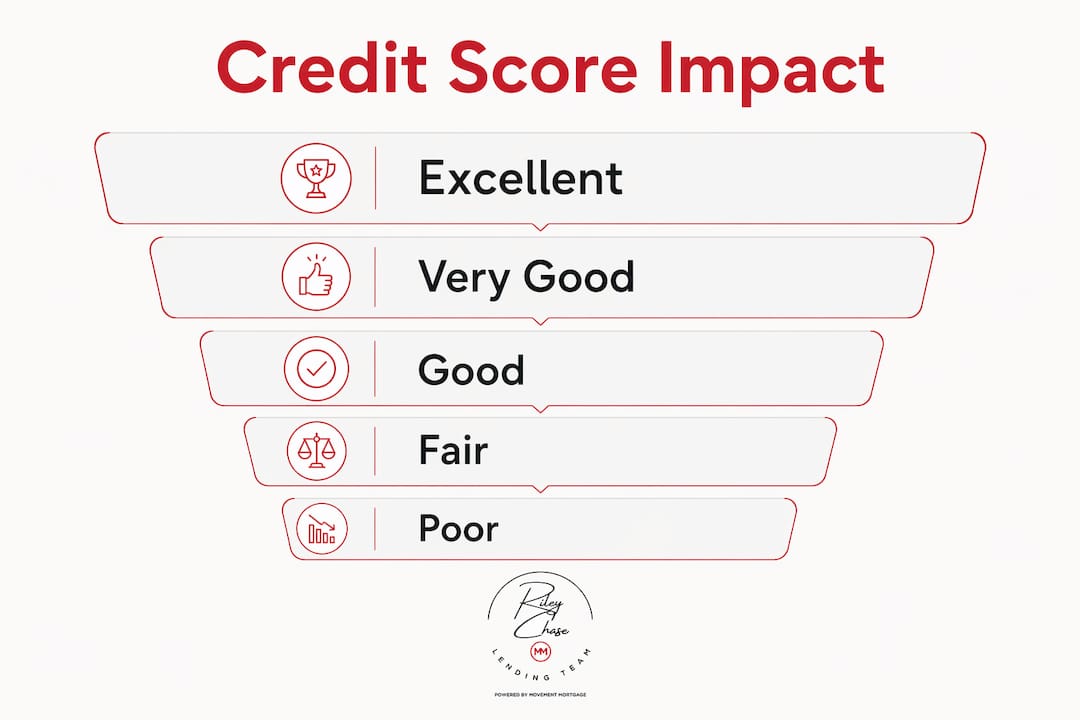
For mortgage purposes, score ranges generally break down like this:
- Below 580: Poor. Most conventional programs are unavailable; FHA access is limited.
- 580–619: Fair. FHA loans become accessible, but rates are high and options are narrow.
- 620–659: Acceptable. Conventional loan eligibility opens up, though rates remain elevated.
- 660–719: Good. Meaningful rate improvements become available in this range.
- 720–759: Very good. You’re approaching the most competitive rate tiers.
- 760 and above: Excellent. Lenders typically offer their best available rates here.
One thing many buyers don’t realize: the score you see in a banking app or on Credit Karma is likely a FICO 8 or FICO 9 score, which is built for credit card issuers. Mortgage lenders use older, mortgage-specific FICO score models that weight long-term payment history more heavily. Your mortgage score can look noticeably different from your consumer score, sometimes by 20–30 points in either direction.

How mortgage lenders actually use your credit score
When you apply for a mortgage, lenders pull your credit report from all three major bureaus: Experian, Equifax, and TransUnion. They don’t average the three scores or take the highest. Instead, they use the middle score to set your rate and evaluate your application. This approach prevents one unusually high or low score from distorting the picture.

The specific models lenders rely on are FICO 2 (from Experian), FICO 4 (from TransUnion), and FICO 5 (from Equifax). These models place greater weight on your long-term repayment patterns rather than recent revolving credit behavior, which is why a few months of good habits won’t dramatically shift your mortgage score the way it might shift a consumer score.
Applying with a co-borrower adds another layer. Lenders use the lower middle score of the two applicants as the qualifying score. If your partner has a 680 and you have a 740, the lender prices the loan at 680. That can raise your rate or limit your program options, even though one borrower has excellent credit.
Credit score is also one piece of a broader underwriting picture. Lenders weigh your debt-to-income ratio, income stability, down payment size, and savings alongside your score. A strong score with a high debt load can still result in a denial, while a slightly lower score paired with a large down payment and low debt may still get approved.
Credit score requirements by loan type and how rates shift by score tier
Different loan programs carry different minimum score requirements, and lenders often add their own overlays on top of government minimums.
| Loan Type | Minimum Score (Program) | Typical Lender Overlay | Notes |
|---|---|---|---|
| Conventional | 620 | 620–659 | Higher scores unlock better rates |
| FHA | 500 (with 10% down) | 580–619 | 580 qualifies for 3.5% down |
| VA | No official minimum | ~620 preferred | Lender overlays vary |
| Jumbo | 700+ | 720–740 | Stricter underwriting overall |
Rate improvements are not linear across the score spectrum. Most of the meaningful savings come from moving out of the lower tiers into the 720–760 range. Rate benefits diminish once you’re above 760–780, so chasing a perfect 850 score won’t move your rate much further. The real payoff is in that 660–760 climb.
Moving from good credit (660–720) to very good (720–760) tends to unlock the most significant interest rate savings relative to higher score ranges, according to realtor.com research. For a borrower with excellent credit (740+), savings can exceed $30,000 over a 30-year loan compared to someone with a score below 700.
PMI is another cost that shifts with your score. Borrowers with lower scores typically pay higher PMI premiums, which are added to the monthly payment until sufficient home equity is built. The difference in PMI costs can significantly increase your annual payments depending on your credit score.
Practical ways to improve your credit score before applying
The good news: credit scores respond to deliberate action, and you don’t need a perfect score to get a great mortgage. You need a good enough score, and a clear plan to get there.
- Pay down revolving balances. Keeping credit card balances below 30% of your credit limit can produce quick, meaningful score gains. Below 10% is even better.
- Check your credit reports for errors. Mistakes on your report can drag your score down unfairly. Review reports from all three bureaus at AnnualCreditReport.com and dispute any inaccuracies well before you apply.
- Avoid opening new credit accounts. Hard inquiries from new credit applications temporarily lower your score. Hold off on new cards, car loans, or any other credit until after your mortgage closes.
- Pay off small outstanding debts. Clearing smaller balances reduces your overall debt load and can improve both your score and your debt-to-income ratio at the same time.
- Keep older accounts open. Length of credit history is a scoring factor. Closing an old card shortens your average account age and can nudge your score down.
For a structured approach to building your score before you apply, the credit score improvement checklist from MyFinja walks through the key steps in detail.
Pro Tip: The fastest score gains usually come from two moves: paying down credit card balances and correcting report errors. Both can show results within 30–60 days, which matters if you’re planning to apply in the near term.
Understanding loan types and why pre-approval puts you in a stronger position
Knowing your credit score is the starting point, but knowing which loan fits your situation is what turns that score into a real offer. Each loan type has its own credit profile and borrower requirements.
- Fixed-rate mortgages lock in your interest rate for the life of the loan, typically 15 or 30 years. They work well for buyers who want predictable payments and plan to stay long-term. A score of 620 or above generally qualifies, though better rates come with higher scores.
- Adjustable-rate mortgages (ARMs) start with a fixed rate for an initial period, then adjust periodically. They can offer lower starting rates for buyers who expect to sell or refinance within a few years.
- FHA loans are government-backed and designed for buyers with lower scores or smaller down payments. The 3.5% down option requires a 580 score; a 500 score may still qualify with 10% down.
- VA loans are available to eligible veterans and active-duty service members. The VA sets no official minimum score, but most lenders prefer around 620. If you qualify, VA loan benefits include no down payment and no PMI.
- Jumbo loans finance properties above conforming loan limits and typically require scores of 700 or higher, along with stronger overall financial profiles.
Pre-approval is where your credit score becomes a concrete number tied to a real loan offer. When you get pre-approved, the lender pulls your credit, reviews your income and assets, and gives you a specific loan amount and rate range. That clarity helps you shop within your actual budget and shows sellers you’re a serious buyer. In competitive markets, a pre-approval letter can be the difference between getting an offer accepted and losing out. Learn more about getting pre-approved and what to expect from the process.
Rileychase can help you move from your current score to your best loan
Your credit score is not a verdict. It’s a starting point, and with the right guidance, most buyers can improve their position before they ever submit an application.

Rileychase works with first-time buyers and experienced homeowners to make the mortgage process clear and approachable. The team walks you through your current credit picture, explains exactly which loan programs fit your score and financial profile, and helps you understand what steps, if any, would meaningfully improve your offer before you apply. No guesswork, no surprises. Just a straightforward conversation about where you stand and what’s possible. Whether you’re ready to apply now or still building toward your goal, explore your loan options with a team that puts your financial confidence first.
Key Takeaways
Your credit score directly shapes your mortgage rate, loan type access, and total borrowing cost, making it the most controllable factor in your home financing outcome.
| Point | Details |
|---|---|
| Score drives your rate | Borrowers with scores above 740 can save over $30,000 compared to those below 700 on a 30-year loan. |
| Lenders use the middle score | Mortgage lenders pull all three bureaus and use your middle FICO score, not the highest or an average. |
| 660–760 is the high-value range | Moving from good to very good credit unlocks the most meaningful rate savings relative to higher score tiers. |
| Loan minimums vary by type | Conventional loans require 620+, FHA allows 580 for 3.5% down, and jumbo loans typically need 700 or higher. |
| Rileychase guides you through it | Rileychase reviews your credit profile and matches you with the loan program that fits your score and goals. |
Recommended

Related Posts